The Hidden Cost Centers Eating Your Amazon Margin (And the One Everyone Ignores)
 Apr 9, 2026
 Key Takeaways
- The most significant hidden costs of selling on Amazon FBA are not always visible on an invoice — semantic relevance gaps compound silently into TACoS inflation and margin erosion.
- COSMO (Amazon's Customer-Obsessed Search and Marketing Optimization system) classifies buyer intent and extracts product attributes from listing content — listings that fail its confidence threshold lose organic placement even with strong reviews and competitive pricing.
- Poor COSMO alignment triggers a cost cascade: lower organic rank → higher PPC dependency → rising TACoS → compressed net margin → less budget to fix the root cause. The loop is self-reinforcing.
- A conservative 3–5 percentage point TACoS creep on a $1.5M revenue book represents $45,000–$75,000 in annual margin loss with no visible root cause in standard reporting.
- Standard Amazon reporting tools (Seller Central, Brand Analytics, third-party dashboards) cannot surface the semantic relevance signals driving organic rank — the mechanism is invisible by design.
The fix is a semantic listing audit, not a new ad strategy — rebuilding content around COSMO's intent clusters, not keyword density, is what restores organic placement and reduces paid dependency.
The Fee Obsession Is Costing You More Than the Fees
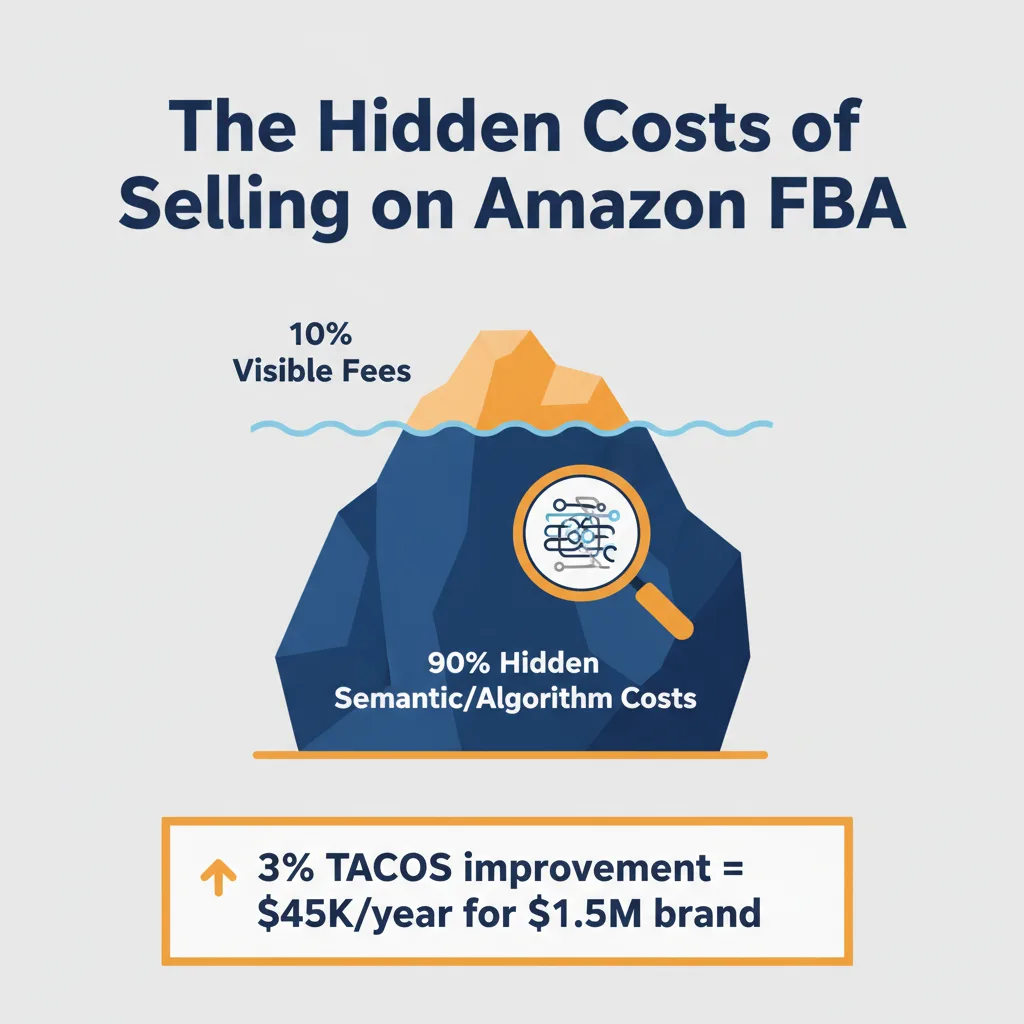
Most conversations about the hidden costs of selling on Amazon FBA start and end with the fee schedule. FBA fulfillment rates, storage surcharges, aged inventory fees, returns processing — these are real costs and they deserve attention. But they are also fully visible. Amazon invoices them. You can model them. You can fight some of them through reimbursement audits.
The fee line is not where mid-market brands lose the most money. It is where they focus the most attention. That mismatch is the actual problem.
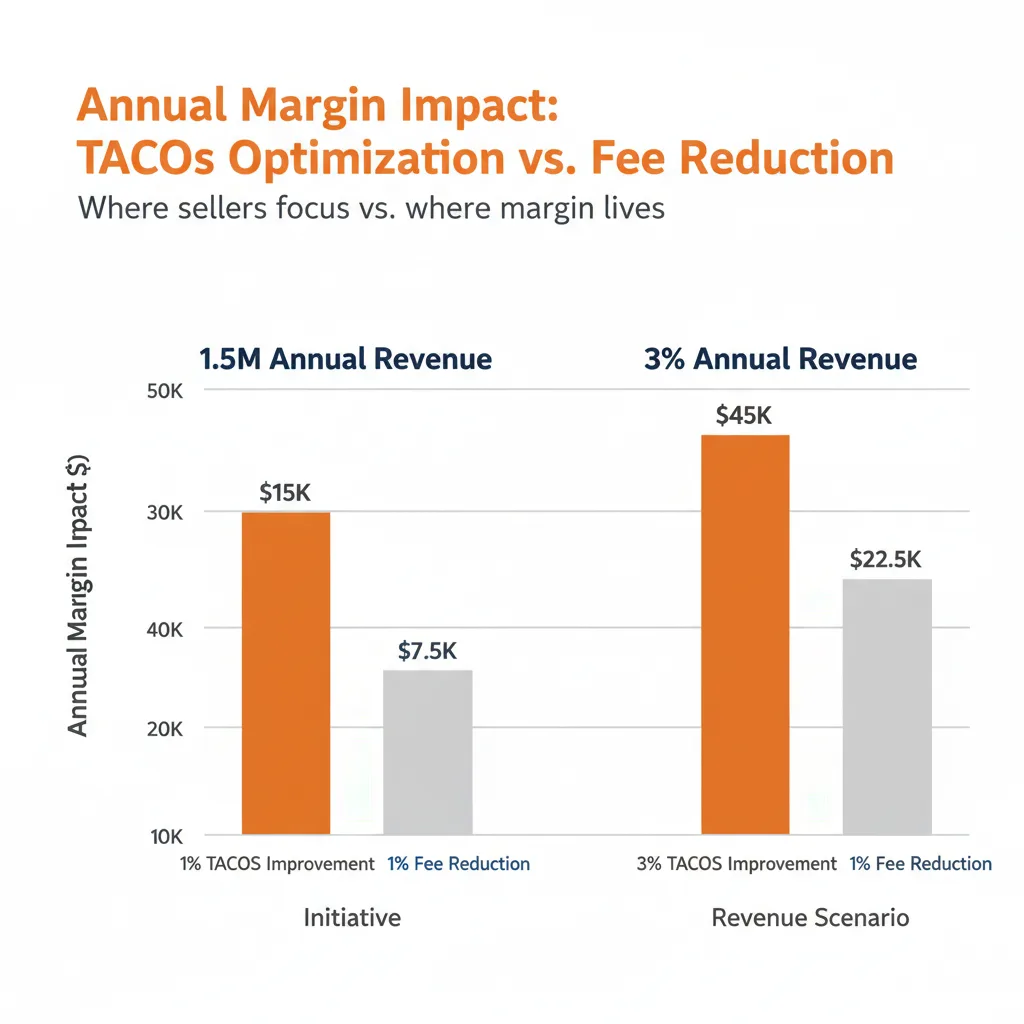
For a brand doing $1.5M a year, a one-percentage-point improvement in TACoS is worth $15,000 annually. A three-point improvement is $45,000. When sellers chase fee reductions and ignore organic rank erosion, they are optimizing the smaller variable and leaving the larger one unmanaged.
The fee structure is context in this article. It is not the thesis. The thesis is this: semantic relevance is an invisible cost center, and almost no one audits it.
What Is COSMO, and Why Does It Determine Your Organic Margin?
COSMO — Amazon's Customer-Obsessed Search and Marketing Optimization system — is the semantic understanding layer that sits beneath Amazon's search ranking. It does not just match keywords to listings. It classifies buyer intent, extracts product attributes from listing content, and uses behavioral signals from purchase history to determine which products genuinely satisfy which queries.
When COSMO can confidently match your listing to a buyer's intent cluster, your organic placement is strong. When it cannot — when your listing is semantically thin, attribute-incomplete, or optimized for exact-match terms rather than natural language — Amazon quietly deprioritizes you, even if your reviews are solid and your price is competitive. The demotion happens upstream of the buy box, in a relevance scoring layer that sellers never see.
This matters because organic placement is not just a traffic channel. It is a margin channel. Organic clicks cost nothing. Paid clicks cost whatever the auction says they cost. When COSMO downgrades your semantic confidence score, you do not lose traffic immediately — you lose cheap traffic. The paid kind fills the gap, and you pay for the difference indefinitely.
The implication for FBA sellers is counterintuitive. You can have excellent review velocity, a competitive price, and a well-funded ad account — and still watch your margins compress — because the algorithm does not fully trust that your product belongs in the results it is serving. That trust is built through semantic relevance, not bids.
How Does Weak Semantic Relevance Trigger a Cost Cascade?
Poor COSMO alignment sets off a chain reaction that compounds across your entire account economics. The cascade follows a consistent pattern: lower organic rank leads to higher PPC dependency, which drives TACoS upward, which compresses net margin, which leaves less budget available to fix the listing that started the problem.
Start at the beginning. A listing with weak semantic signals — one that Amazon's intent classification system cannot confidently place in a buyer's relevant result set — loses organic share. This happens incrementally, not overnight. You might not notice the rank drop for weeks.
When organic sessions decline, the shortfall shows up in your conversion data. Most sellers' instinct is to increase ad spend to recover volume. That instinct is correct in the short term and damaging in the long term. The additional spend does recover some traffic, but at a higher cost per click because your quality signal to the algorithm is weaker. Lower relevance scores correlate with higher CPCs across competitive categories.
Now the TACoS number moves. Mid-market FBA brands typically run TACoS in the 10–18% range. A conservative three-to-five percentage point creep on a $1.5M revenue book costs $45,000–$75,000 annually. That is not a projection — it is basic arithmetic on a known benchmark range. The seller sees rising TACoS and often responds by cutting bids, which accelerates the organic decline, which forces the spend back up. The loop closes on itself.
The net margin impact is real and it is invisible. No line item on your P&L says "cost of semantic misalignment." It reads as PPC spend. It reads as lower organic conversion. It reads as a TACoS problem with no obvious root cause.
In our client work, we consistently see this pattern in accounts where listing content was built around a keyword research tool rather than intent architecture. The keyword density looks fine. The backend attributes are partially filled. The title has the category term in it. But COSMO's attribute extraction cannot confidently answer the questions a buyer is implicitly asking, and the algorithm prices that uncertainty into your placement.
Why Can't Standard Amazon Reporting Surface This Problem?
Standard seller reporting — Seller Central dashboards, Brand Analytics, most third-party tools — is built around measurable outputs: sessions, conversion rate, ACoS, TACoS, organic rank position. None of these tools report on the input that drives them: semantic relevance confidence.
You can see that your organic rank dropped. You cannot see why COSMO deprioritized you. You can see that your CPC rose. You cannot see that it rose because your listing's attribute completeness score fell below a threshold Amazon never publishes. The mechanism is invisible by design — not maliciously, but because Amazon's systems are optimizing for buyer satisfaction, not seller transparency.
This is why the problem persists at mid-market scale. Brands that reach $1M–$2M in revenue have usually done enough right to get there. Their listings are not terrible. They rank for something. But "not terrible" is a different standard from "semantically complete," and the gap between those two standards is measured in margin points, not just ranking positions.
The fix is not a new ad strategy. It is a listing audit that works backward from COSMO's intent clusters — the natural language groupings of buyer behavior that the algorithm uses to classify queries — and asks whether your content provides confident attribute answers to each one.
What Does a Semantic Listing Audit Actually Look Like?
A semantic listing audit is a structured review of your listing content against COSMO's likely intent classification for your category, identifying gaps between what buyers are asking and what your listing confirms. It is not a keyword gap analysis. It produces a different output and solves a different problem.
The process starts with intent mapping. For a given ASIN, what are the primary use cases, buyer profiles, and contextual situations a customer might be in when they find this product? A kitchen tool is not just a "kitchen tool." It is a meal prep aid for someone cooking for four. It is a compact-storage solution for someone with a small apartment. It is a home chef upgrade for someone who just watched a cooking video. Each of those intent clusters carries different attribute signals.
Next, you assess your listing's content against those clusters. Does your title, bullet points, description, and backend attribute data provide confident answers to the implicit questions each cluster is asking? Not keyword mentions — confident, contextually coherent answers. "Made for meal prep" is weaker than a description that naturally describes how the product behaves during weekly batch cooking. COSMO reads the latter as semantically richer.
One brand we worked with sold premium kitchen tools at a $40–$80 price point. Their listings were keyword-optimized in the traditional sense — high search volume terms, backend fields filled with category phrases. When we rebuilt their content architecture around COSMO's intent clusters — incorporating semantic variants like "meal prep," "home chef workflow," and "compact storage" in contextually natural ways rather than as inserted keyword phrases — the results followed within 60 days. Organic session share increased on core ASINs. Sponsored spend on those same ASINs dropped as organic compensated. Blended margin improved without a price change or new creative.
The mechanism was not mysterious. COSMO's confidence in matching those listings to buyer intent improved. The algorithm rewarded that with placement. The placement reduced paid dependency. The economics followed the relevance.
Amazon's AI shopping assistant Rufus, which handles conversational product queries, also draws on this same semantic layer. If Rufus cannot confidently recommend your product in response to a natural-language question — "what's a good compact tool for meal prep?" — you are missing a traffic channel that is growing quickly and costs nothing to capture once your listing is semantically complete.
How to Assess Whether Your Listings Have This Problem
You likely have a semantic relevance problem if three or more of the following are true for your core ASINs.
Your TACoS has risen by two or more percentage points over the past six months without a corresponding increase in competitive pressure or a significant price change. Your organic rank for primary keywords is lower than it was twelve months ago despite stable or improving review counts. Your conversion rate is lower on organic traffic than on paid traffic by a meaningful margin — suggesting that the buyers Amazon is sending organically are less qualified matches than the ones your ads are specifically targeting. Your backend attributes are partially filled, or were filled by copying competitor listings rather than by mapping your product's specific attributes to buyer use cases. Your product description reads as a keyword list with connecting words rather than as a coherent, natural-language explanation of what the product does and who it is for.
None of these signals is individually conclusive. Together, they indicate a listing that COSMO is classifying with lower confidence than your price, reviews, and ad spend warrant. That gap is costing you margin every day it exists.
The margin problem described in this article is auditable. It is not a market condition you wait out — it is a listing condition you fix. Amazify's semantic listing audits map your core ASINs against COSMO's intent architecture, identify where attribute confidence is falling short, and rebuild the content foundation that organic placement depends on. This is the work that reduces paid dependency without touching your bid strategy.
If your TACoS has moved in the wrong direction and your standard reporting cannot explain why, that is the right moment for a listing-level audit.
Frequently Asked Questions
Most sellers focus on visible costs — FBA fulfillment fees, storage charges, and return processing — but the most damaging hidden cost is organic margin erosion caused by poor semantic relevance. When Amazon's COSMO system cannot confidently match a listing to buyer intent, organic placement drops, PPC dependency rises, and TACoS inflates, often by several percentage points, without any single line item explaining why.
COSMO classifies buyer intent and extracts product attributes from listing content to determine which products belong in a given result set. A listing that scores low on COSMO's attribute confidence threshold gets deprioritized in organic results even when reviews, price, and conversion history are strong. The consequence is a shift from free organic traffic to paid traffic, which directly raises CPCs and TACoS over time.
Rising TACoS without a bid change typically signals organic rank erosion, not an ad efficiency problem. When organic sessions decline — often because of weakening semantic relevance signals — sellers compensate by spending more on ads to maintain volume. The additional spend raises the advertising cost line while total sales stay flat, which pushes TACoS upward. The root cause is the listing, not the campaign.
A semantic listing audit reviews your listing content against the intent clusters Amazon's algorithm uses to classify buyer queries — asking whether your title, bullets, description, and backend attributes provide confident, contextually coherent answers to the questions buyers are implicitly asking. Keyword research identifies terms by search volume. A semantic audit identifies whether your content gives Amazon's systems enough signal to confidently place your product in front of the right buyers.
Yes. Rufus draws on the same semantic layer as COSMO when generating conversational product recommendations. If your listing lacks the natural-language context Rufus needs to confidently recommend your product in response to a query like "what's a good compact tool for weekly meal prep," you are absent from a growing, zero-cost traffic channel. Listings optimized for semantic completeness perform better in both traditional search and Rufus-driven discovery.
The clearest indicators are: TACoS rising without obvious competitive changes, organic rank declining despite stable or improving review counts, conversion rate significantly lower on organic traffic than on paid traffic, and product descriptions that read as keyword lists rather than natural-language explanations of the product's use cases. Three or more of these signals together suggest a COSMO confidence gap that is costing you margin daily.
Ready to stop leaving money on the table?
Get a free margin audit and see exactly how much profit you're missing.
Book Your Free Audit →