Amazon Ads Just Opened the Door to AI Agents - Here's What the New MCP Server Actually Changes
 May 8, 2026
 For the last few years, "AI in advertising" has mostly meant smarter bidding algorithms and copy generation. That framing is about to feel quaint. On February 2, 2026, Paula Despins, VP of Ads Measurement at Amazon Ads, announced that the Amazon Ads MCP Server is now in open beta - and it quietly reshapes how every agent, copilot, and automation platform will interact with Amazon's advertising stack.
If you operate Amazon ad campaigns, build software for sellers, or run an agency, this is one of the more consequential infrastructure announcements of the year. Here's why.
What was actually announced
The Amazon Ads MCP Server is built on the Model Context Protocol - the open standard, originally introduced by Anthropic, that defines how AI systems plug into external tools and data sources. In simple terms, it's a universal adapter between large language models and the world's APIs.
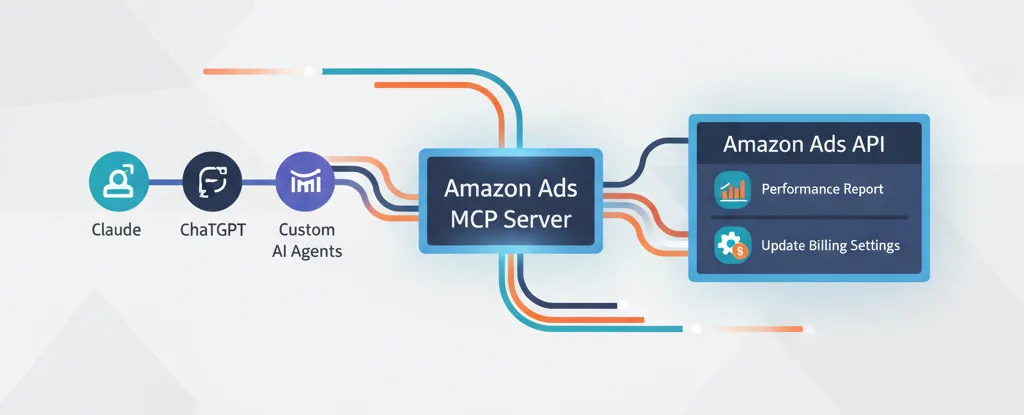
Amazon's MCP Server sits between AI agents and the Amazon Ads API. It translates natural-language prompts into structured API calls, so an agent can create a campaign, pull a performance report, or update billing settings without anyone writing a custom integration to glue the two systems together.
The server is available globally to any Amazon Ads partner with active API credentials, and it works with custom-built agents as well as consumer AI platforms like Claude, ChatGPT, and Gemini.
The problem this is really solving
Amazon already has a robust Ads API. So why bother with another layer?
Because traditional APIs were never designed for agents. They expose individual capabilities - create-this, fetch-that - one endpoint at a time. A human developer (or a careful piece of orchestration code) is expected to know which sequence of calls accomplishes a real-world goal.
Agents don't naturally know that. Drop an LLM in front of a few hundred raw endpoints and ask it to "launch a Sponsored Products campaign in Canada," and you'll get a brittle, error-prone improvisation. The agent has to guess at the right call order, the right parameter shapes, and the right validation steps. Even when it works, it's slow and unreliable.
This is the gap MCP - and Amazon's specific implementation - is designed to close.
The interesting part: pre-built workflow tools
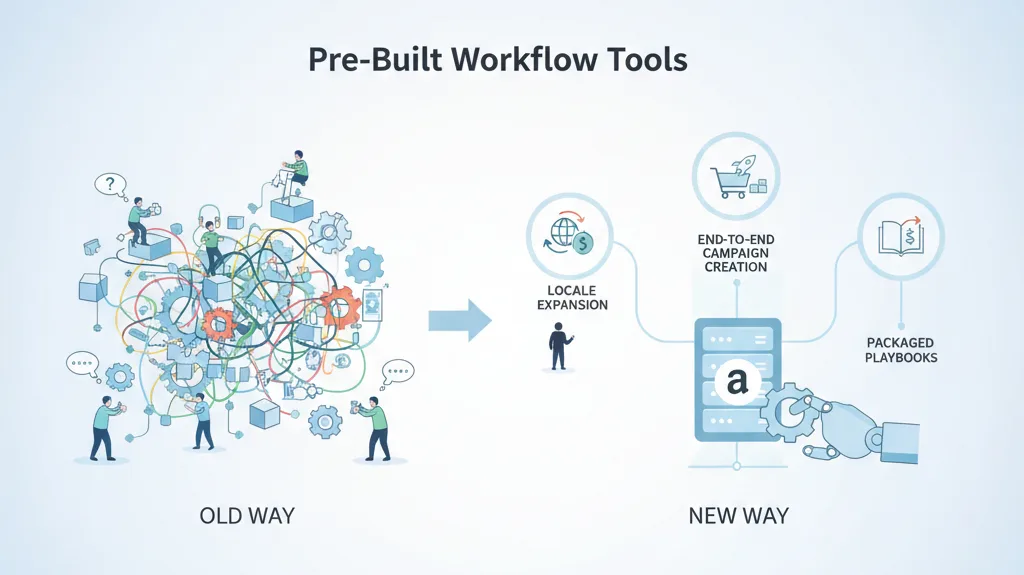
The headline isn't really "Amazon now has an MCP Server." Plenty of companies are shipping MCP servers right now. The more important detail is buried halfway down the announcement: Amazon isn't just exposing endpoints. They're shipping opinionated, multi-step workflows as MCP tools.
Two examples they highlighted:
Locale expansion. If you're already running campaigns in the U.S. and Canada, there's a single tool that takes you into another country with one prompt. What used to be a multi-day project of replicating campaign structures, adjusting bids, localizing copy, and reconfiguring budgets becomes a conversation.
End-to-end Sponsored Products campaign creation. Normally you'd make three or more API calls - create the campaign, set up ad groups, create the ads. Amazon's new tool wraps all of that into a single workflow. The agent produces a ready-to-launch campaign that just needs human review and approval.
Think of these tools as packaged playbooks. The agent doesn't have to figure out the choreography; the workflow already knows it.
Why this matters more than the average MCP launch
A few things make this particular release different from the wave of MCP servers that have shipped over the past year.
It's coming from the platform, not a third party. When the source-of-truth platform builds the integration layer itself, you get authoritative coverage of the API surface, faster updates as new features ship, and a level of reliability that wrapper projects can't match.
The "tools as workflows" pattern is the right abstraction. Most MCP servers today are thin wrappers around existing APIs. They expose the same atomic operations and hope the model figures out how to chain them. Amazon is going a step further and shipping the chains themselves. That's a meaningful design choice, and it's likely the pattern other major platforms will follow.
Standards-based means portable. Because MCP is an open protocol, the same Amazon Ads tools work whether you're calling them from Claude Desktop, a custom agent built on the Anthropic SDK, an internal automation in n8n, or a partner platform. You build the integration once.

Who should care
If you fall into any of these buckets, this is worth your attention:
Amazon sellers and brands running their own ads will eventually feel this through the AI tools they already use. The Amazon Ads console got conversational capabilities through Ads Agent at unBoxed 2025; this opens the same surface area to anything outside the console.
Agencies and operators get to wrap real workflow automation around their own playbooks without maintaining a brittle stack of API glue. You're now competing on strategy and judgment, not on who has the most engineers keeping integrations from breaking.
Software vendors in the Amazon ecosystem - repricers, audit tools, PPC platforms, listing optimizers - get a path to add agentic features without building an Ads API integration from scratch.
Builders of horizontal AI agents and copilots can now legitimately list "manages your Amazon ad campaigns" as a feature.
A few honest caveats
A pre-built workflow tool is only as good as its design. The "expand to a new country" workflow is going to make some assumptions about how to translate your strategy across locales. Those assumptions might be excellent, or they might be generic. Real-world adoption will tell us which.
There's also the standard agent-reliability question. Even with workflow tools doing the heavy lifting, you still want human review on anything that touches budget, billing, or live campaigns. Amazon's framing of the Sponsored Products tool - "ready-to-launch campaign that only needs review and approval" - is the right posture. Don't let the agents push to production unsupervised.
And open beta means open beta. Expect rough edges. Expect tools to be added, removed, and reshaped. Build accordingly.
The bigger picture
Strip away the news cycle and what Amazon is really doing here is acknowledging that the next layer of advertising infrastructure isn't another dashboard or another API - it's a conversational, agent-native interface to the work itself. Whoever owns that layer owns the surface where strategy meets execution.
By going open and standards-based, Amazon is betting that the smart move isn't to lock advertisers into Ads Agent inside the console. It's to make sure that wherever the agent lives - inside the console, inside Claude, inside a third-party platform, inside a custom-built tool - the path back to Amazon Ads is the shortest one.
That's a meaningful bet, and it's one that should reshape how the rest of us build.
Source: Introducing the Amazon Ads MCP Server (Amazon Ads, February 2, 2026)
Ready to stop leaving money on the table?
Get a free margin audit and see exactly how much profit you're missing.
Book Your Free Audit →