How Amazon's New Fuel Surcharge Impacts Your FBA Profit Margins
 Apr 16, 2026
 If your brand is above $1M in annual FBA revenue and you have not formally modeled your surcharge exposure against your current inbound freight patterns, you are likely leaving several thousand dollars per year on the table in recoverable margin.
Amazify works with mid-market FBA brands to audit inbound supply chain costs, model the placement fee trade-off, and rebuild unit economics at current fee rates. If you want a second set of eyes on your numbers, start with our free audit service.
Key Takeaways
-
The Amazon fuel surcharge currently sits at 3.5% of base FBA fulfillment fees, applied beginning April 2026, and it fluctuates with fuel and logistics indices rather than holding at a fixed rate.
-
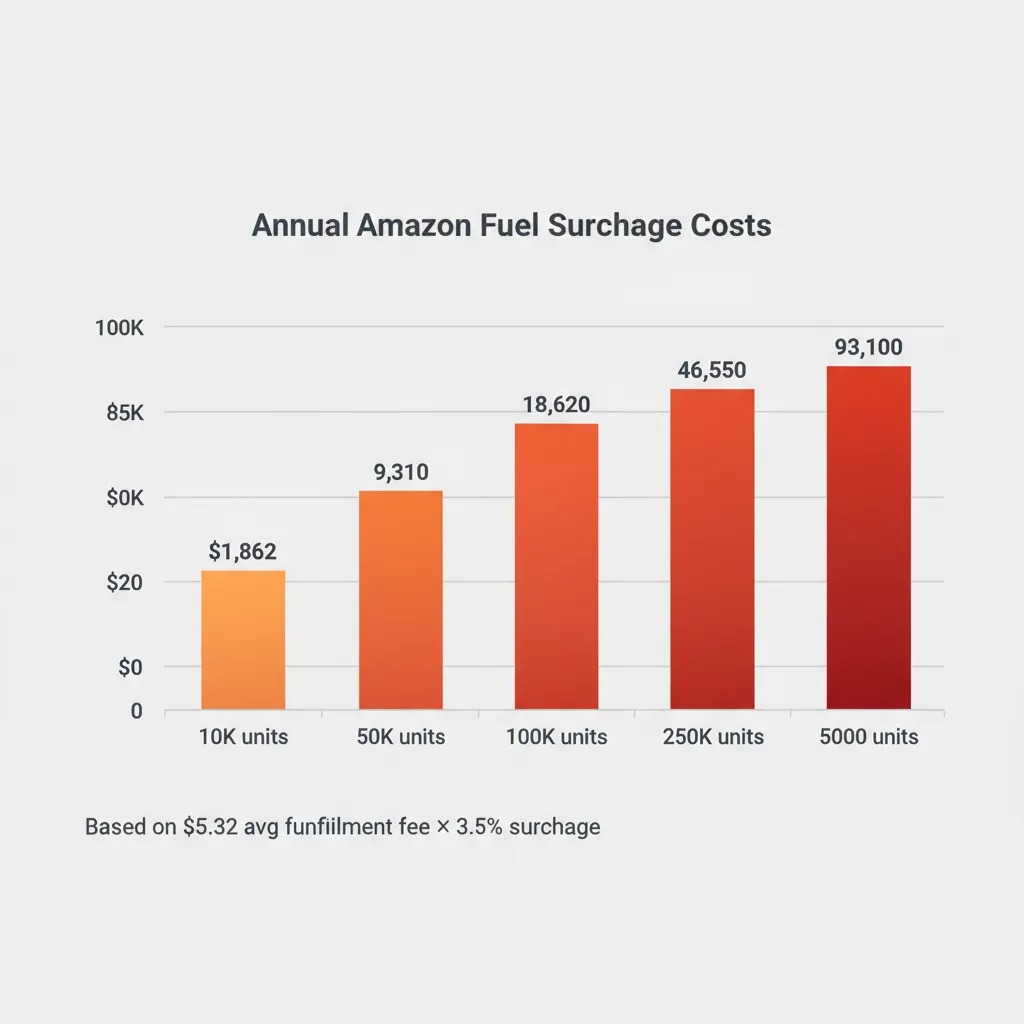
For a brand moving 100,000 units per year at a $5.32 base fulfillment fee, the surcharge translates to roughly $18,600 per year at 3.5%. At a $7.50 base fee, the same rate and volume produces roughly $26,250, which is where the upper range of surcharge exposure sits for larger or heavier products.
-
The surcharge is not purely a fixed pass-through cost. Inbound shipment frequency, carton density, and fulfillment center routing all influence your total per-unit cost exposure.
-
Consolidating inbound shipments from weekly to bi-weekly cycles reduces per-unit inbound handling costs and can cut overall freight spend by 10-18%, compounding the savings created by lower surcharge exposure.
-
Right-sizing master carton dimensions reduces dimensional weight billing on inbound freight and reduces the number of carrier scans subject to fuel surcharge pass-throughs, with brands reporting 6-12% reductions in per-unit inbound freight spend.
-
Checking the current surcharge rate only at annual fee reviews means you are perpetually behind. The rate adjusts monthly. Treat it as a live signal, not a static line item.
What Is the Amazon Fuel Surcharge and How Is It Calculated?
The Amazon fuel surcharge is a percentage-based fee applied on top of standard FBA fulfillment costs, designed to offset Amazon's rising fuel and logistics expenses. As of April 2026, the rate is 3.5% of base fulfillment fees. Check Amazon Seller Central FBA fee schedule. It applies to third-party sellers using Fulfilled by Amazon and is subject to monthly adjustment.
The calculation itself is straightforward. Take your base fulfillment fee per unit, multiply it by the current surcharge rate, and you have your per-unit surcharge cost. At 3.5% on a $5.32 base fee, that is roughly $0.19 per unit. At 100,000 units annually, you are looking at $18,600 a year. That number climbs as your base fee does: a product in a larger size tier at a $7.50 base fee generates roughly $0.26 per unit in surcharge, or about $26,250 at the same volume. The exposure scales with both unit count and size tier, which is why lighter, smaller products feel this fee very differently than bulkier ones.
What sellers miss is that this rate is not static. Amazon adjusts it in response to fuel indices and broader logistics cost benchmarks. A seller who checks the rate once at the beginning of the year and moves on is working with stale numbers by month two. The current rate always lives in the Amazon Seller Central fee schedule, and that is the only place you should be reading it. Supply Chain Dive reporting on Amazon's April 2026 surcharge announcement
Why the Rate Matters More at Scale
The surcharge compounds. A brand at $1M revenue with tighter margins feels a 3.5% fee add-on differently than the math suggests, because it stacks on top of referral fees, storage fees, and inbound freight costs that have also risen. When average FBA fulfillment fees have increased by approximately 5.2% in aggregate over recent years, the combined effect on net profit per unit can push a thin-margin product into negative territory. The surcharge is not the only pressure; it is one layer in a stack that has been rising simultaneously.
How Does Inbound Shipment Frequency Affect Your Surcharge Exposure?
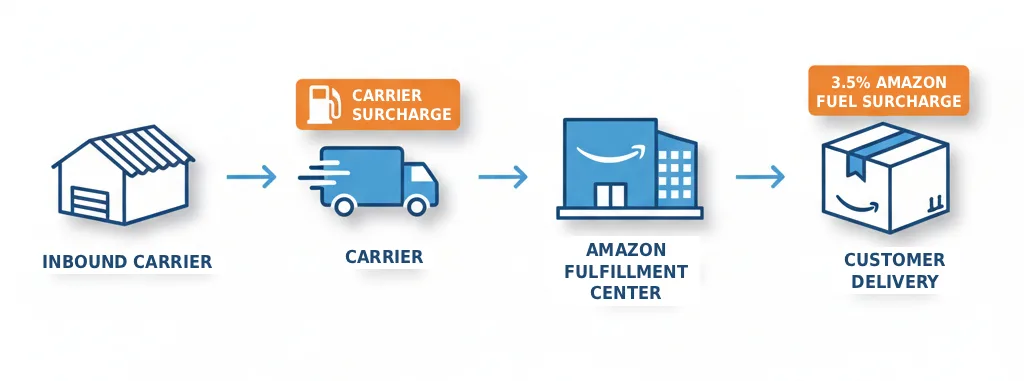
Reducing inbound shipment frequency directly lowers your per-unit inbound handling cost, which compounds the savings you create by managing surcharge exposure. Frequent small-carton replenishments generate more carrier touchpoints, more fuel surcharge pass-throughs from your freight carriers, and higher per-unit handling costs inside Amazon's fulfillment network.
3PL operators who consolidate inbound shipments from weekly to bi-weekly cycles report per-unit inbound cost reductions in the range of 10-18%. Check Industry 3PL benchmarking reports on inbound consolidation. The logic is simple: fewer moves mean fewer fuel-indexed billing events between your warehouse and Amazon's fulfillment centers.
This is where the surcharge stops being a passive tax and starts being a signal. If you are replenishing weekly in small-carton loads because your inventory planning is reactive rather than deliberate, the surcharge is revealing a deeper inefficiency. You are paying for the operational habit, not just the fee.
In our work with mid-market FBA brands, we consistently see sellers defaulting to high-frequency small replenishments because it feels safer from a stockout perspective. The unit economics rarely support that instinct once you model out the total inbound cost. The tradeoff between replenishment frequency and per-unit inbound cost is one of the most consistently undermodeled decisions in mid-market FBA operations. Sellers focus on avoiding stockouts. They rarely calculate what they are paying in compounded inbound costs to maintain that buffer through frequency rather than volume.
Can Carton Density Optimization Reduce Your Fuel Surcharge Impact?
Optimizing carton density reduces the dimensional weight that carriers bill against, which in turn reduces the number of high-cost freight events between your origin and Amazon's fulfillment centers. Brands that have right-sized their master cartons to minimize wasted cubic space report per-unit inbound freight reductions of 6-12%.
The connection to the Amazon fuel surcharge is direct. Every carrier scan in your inbound freight chain carries a fuel surcharge applied by that carrier, typically calculated against the billable weight of the shipment. If your cartons are running at 60% of their rated cubic capacity, you are billing dimensional weight on air. You are paying fuel surcharges on packaging inefficiency.
Right-sizing is not a one-time project. Carton optimization needs to be revisited whenever your product dimensions change, when you add new SKUs, or when you switch manufacturers. A master carton spec that worked for your original product run may be significantly suboptimal for a reformulated or repackaged version. The carton you negotiated with your factory two years ago is not necessarily the right carton for the product you are shipping today.
The Density-to-Fee Connection Most Sellers Miss
Most sellers optimize their product packaging for consumer experience and stop there. The inbound master carton is an afterthought. That distinction costs money at scale because the master carton is what your freight carriers are billing against, and it is what determines how many palletized slots your shipment consumes inside Amazon's inbound network.
A brand moving 100,000 units per year through poorly optimized master cartons might be generating 15-20% more freight events than necessary. Each of those events carries a carrier-side fuel surcharge before the Amazon FBA fuel surcharge even enters the calculation. The Amazon fee gets the attention because it appears as a line item in Seller Central. The carrier-side surcharge accrues quietly across dozens of shipments and rarely gets formally attributed to the packaging decision that caused it.
The fix is not complicated. Pull your current carton dimensions. Calculate your utilization rate as actual product cubic volume divided by carton interior cubic volume. If that number is below 75%, you have a case to model an alternative spec. The potential freight savings need to be weighed against re-tooling or repackaging costs, but for brands at 100,000 units annually, the math often closes within one to two shipment cycles.
Does Fulfillment Center Routing Change What You Pay?
Fulfillment center routing affects your per-unit inbound transport cost, which directly influences how much total fuel-indexed spend you carry per unit fulfilled. When Amazon splits your inventory across multiple fulfillment centers, your inbound freight distance increases, as does your carrier-side fuel surcharge exposure.
Amazon's Inventory Placement Service allows sellers to send all units for a given SKU to a single fulfillment center, after which Amazon handles redistribution. The trade-off is a per-unit placement fee, but for sellers with high inbound freight costs and poor routing, that fee often comes out ahead of the alternative. The break-even calculation is specific to your product size tier, your carrier rates, and the geographic relationship between your 3PL and Amazon's fulfillment network.
The math here is not universal. Sellers with fulfillment centers located close to their 3PL or manufacturer may find that the distributed routing Amazon defaults to is actually cheaper once the placement fee is included. The point is to run the numbers rather than accept the default.
We have seen brands paying an effective 12-15% more per unit in total inbound cost simply because they never modeled the placement fee trade-off against their actual carrier rates. The Amazon fuel surcharge, in those cases, was the smaller inefficiency sitting on top of a larger one. Fulfillment center routing decisions compound with surcharge exposure in ways that only become visible when you model total inbound cost per unit rather than looking at individual fee line items in isolation. For brands above $1M in revenue, that distinction is often worth several thousand dollars annually without changing a single thing about the product itself.
How to Audit Your Supply Chain for Surcharge Inefficiency
A surcharge inefficiency audit surfaces the operational decisions that are amplifying your fee exposure before you ever see a line item in Seller Central. It has four components: shipment frequency review, carton density review, routing cost modeling, and unit economics rebuild.
Step 1: Pull Your Inbound Shipment History
Go into Seller Central and export your inbound shipment log for the last 90 days. Count the number of discrete shipments per SKU. If you are sending the same ASIN more than twice per month in separate carton shipments, you are almost certainly paying more per unit in combined carrier-side and Amazon-side fuel-indexed costs than a consolidated approach would require. Flag any SKU with more than eight discrete inbound shipments in 90 days as a consolidation candidate.
Step 2: Audit Your Master Carton Specs
Pull your current master carton dimensions and compare them to the actual cubic footprint of your product plus required dunnage. Calculate utilization as a percentage of rated cubic capacity. Anything below 75% utilization is worth modeling against an alternative carton spec. The potential freight savings should be weighed against any re-tooling or repackaging costs, but at meaningful unit volumes the case usually closes quickly.
Step 3: Model the Placement Fee Trade-Off
Pull your last 60 days of inbound shipment data and calculate your average per-unit freight cost under the current distributed routing. Then model what the same volume would cost under Inventory Placement Service, including the per-unit placement fee. The break-even point varies by product size tier and origin location. Run it for your top five ASPs by unit volume. The result may surprise you in either direction, and either outcome is useful information.
Step 4: Rebuild Your Unit Economics at the Current Surcharge Rate
Most sellers built their margin models when the surcharge was lower or did not exist. Rebuild your per-unit P&L using the current rate from Amazon Seller Central and your actual base fulfillment fee. Then model what a 10-15% reduction in inbound freight cost does to your net margin per unit. That is the opportunity size you are working toward, and it is the number that tells you whether the operational changes are worth prioritizing now or scheduling for the next planning cycle.
Amazon Fuel Surcharge: What It's Really Costing FBA Sellers
The Amazon fuel surcharge is a variable fee added on top of standard FBA fulfillment costs, calculated as a percentage of base fulfillment fees and adjusted in response to fuel and logistics cost indices. Amazon announced a 3.5% fuel and logistics-related surcharge on FBA fulfillment fees beginning April 2026, and industry data suggests average FBA fulfillment fees have already risen by approximately 5.2% when accounting for related cost increases.
Here is the number most sellers have never actually added up. A brand doing $1.5M a year, moving roughly 100,000 units at a $5.32 base fulfillment fee, absorbs somewhere between $18,600 and $27,000 annually from the surcharge alone. That is not a rounding error. It is a budget line that most sellers have mentally filed under "cost of doing business" and stopped thinking about.
That is the wrong frame. The sellers gaining margin right now are not just accepting this fee. They are looking upstream at the supply chain decisions that partially determine how much exposure they carry.
Amazon's FBA fuel surcharge is costing mid-market sellers more than they realize. Learn how supply chain decisions - not just fees - drive your exposure.
-
Pull the current fuel surcharge rate from your Amazon Seller Central fee schedule at the start of each month, not at year-end. The rate adjusts monthly, and unit economics built on a stale figure will systematically understate your true cost per unit.
-
Calculate your annualized surcharge exposure before making any pricing or margin decision. Multiply your base fulfillment fee by the current surcharge percentage, then by your annual unit volume. On a $5.32 base fee at 3.5%, a brand moving 100,000 units is carrying roughly $18,600 in surcharge cost per year. Most sellers have never done this math.
-
If you are currently shipping inbound freight weekly, model a shift to bi-weekly. Consolidating shipment frequency into fewer, larger sends has been cited by 3PLs as reducing per-unit inbound handling costs by 10-18%. That reduction compounds on top of any surcharge savings, so the combined effect is larger than either number alone.
-
Audit your master carton cubic utilization. If you are below 75% fill rate, you are paying dimensional weight charges on empty air, and each carrier scan on that air is subject to fuel surcharge pass-throughs. Right-sizing cartons to 75% or higher removes that exposure at the freight carrier level, before the Amazon surcharge even applies.
-
Treat a rising surcharge as an operational diagnostic, not just a fee. If your per-unit surcharge exposure is growing faster than your volume, the likely causes are upstream: excessive shipment touchpoints, low carton density, or suboptimal fulfillment center routing. Address the operational root cause rather than accepting the fee as fixed.
-
Set a unit-economics review threshold: if your total fuel-indexed cost per unit crosses 5% of your base fulfillment fee, treat it as a trigger to re-evaluate your inbound supply chain configuration, not just your pricing. That threshold forces a structural response instead of a passive absorption.
Frequently Asked Questions
The Amazon fuel surcharge is a variable percentage fee added on top of standard FBA fulfillment fees, applied to third-party sellers using Fulfilled by Amazon. As of April 2026, Amazon set the rate at 3.5%, though it adjusts in response to fuel and logistics cost indices. The current rate is always published in the Amazon Seller Central fee schedule.
The surcharge is calculated as a percentage of your base FBA fulfillment fee per unit. At 3.5% on a $5.32 standard fulfillment fee, the per-unit cost is approximately $0.19. For high-volume brands, this compounds quickly: 100,000 units per year at that rate generates roughly $18,600 in annual surcharge spend.
Sellers using FBA cannot avoid the surcharge outright, as it applies to all units fulfilled through Amazon's network. However, sellers can reduce their total fuel-indexed cost exposure by consolidating inbound shipments, optimizing carton density to eliminate dimensional weight billing on wasted space, and modeling the trade-off between distributed routing and Amazon's Inventory Placement Service.
Yes. The rate adjusts monthly based on fuel and logistics cost benchmarks. Amazon announced the April 2026 rate at 3.5%, but sellers should check the current rate directly in Seller Central rather than relying on any third-party report, including this one. Using a stale rate in your margin model is one of the most common errors we see in mid-market FBA unit economics.
Higher inbound shipment frequency generates more carrier touchpoints between your warehouse and Amazon's fulfillment centers. Each carrier movement carries a carrier-side fuel surcharge, calculated against billable weight, before the Amazon-side surcharge even applies. Reducing shipment frequency through better inventory planning directly reduces the number of fuel-indexed billing events in your supply chain.
Seller Fulfilled Prime removes FBA fulfillment fees and the associated fuel surcharge, but replaces them with your own fulfillment infrastructure costs, carrier rates, and the full weight of carrier-side fuel surcharges on outbound shipments. For most mid-market brands, FBA remains the lower total-cost option once you account for the Prime badge, customer return handling, and operational overhead of in-house fulfillment. The surcharge optimization levers described in this article will typically deliver better ROI than a full infrastructure switch.
Ready to stop leaving money on the table?
Get a free margin audit and see exactly how much profit you're missing.
Book Your Free Audit →