Inside Amazon's Alexa+ Patent: The 3-Stage System Deciding Which Products Get Surfaced
 May 19, 2026
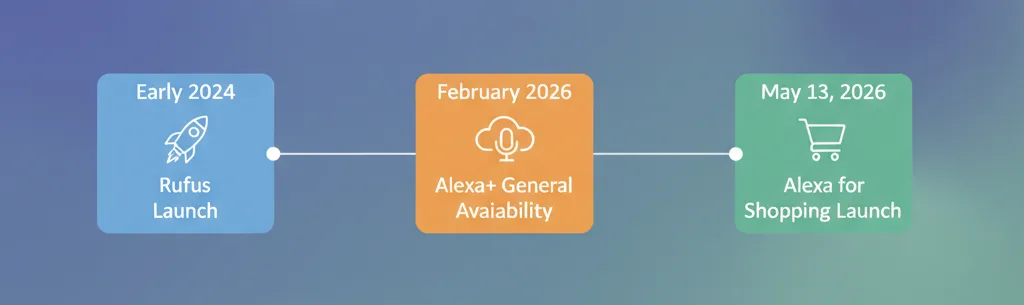
 On May 13, Amazon merged Rufus into Alexa+ and called the unified system "Alexa for Shopping," a single agent that now runs across the Amazon Shopping app, Amazon.com, Echo Show, Alexa.com, and the Alexa app. The brand change traveled fast. The architecture behind it has been on the public record for over a year. Patent US 12,141,529, granted to members of the same team that built Rufus, describes a system that answers broad product questions by analyzing attributes across many listings at once. Amazon e-commerce manager Andrew Bell surfaced and analyzed the patent in early 2025 (work covered by Forbes), predicting that Rufus would fuse with Alexa's voice interface into one product intelligence layer. The piece below walks through what the patent reveals about how products get discovered, and what it changes for FBA sellers above $1M in revenue. Retail Media Breakfast Club
Key Takeaways
-
Amazon launched Alexa for Shopping on May 13, 2026, merging Rufus into Alexa+ across the Amazon app, website, Echo Show, and Alexa surfaces, with no Prime membership required.
-
300 million customers used Rufus in 2025, and Alexa+ now spans hundreds of millions of devices. The merger consolidates two systems that previously operated separately. Axios
-
Patent US 12,141,529, surfaced by Amazon e-commerce manager Andrew Bell and analyzed in Forbes by Kiri Masters, describes a 3-stage process: named entity recognition, attribute aggregation across multiple listings, and templated conversational answers.
-
The patent shows the direction Amazon has been building toward, not the exact technical implementation that shipped on May 13. COSMO is still doing the semantic heavy lifting underneath.
-
The shopping journey flips from "find products, then research attributes" to "specify attributes, then discover qualifying products." Listings now contribute to aggregate, category-level answers, not just one-to-one keyword matches.
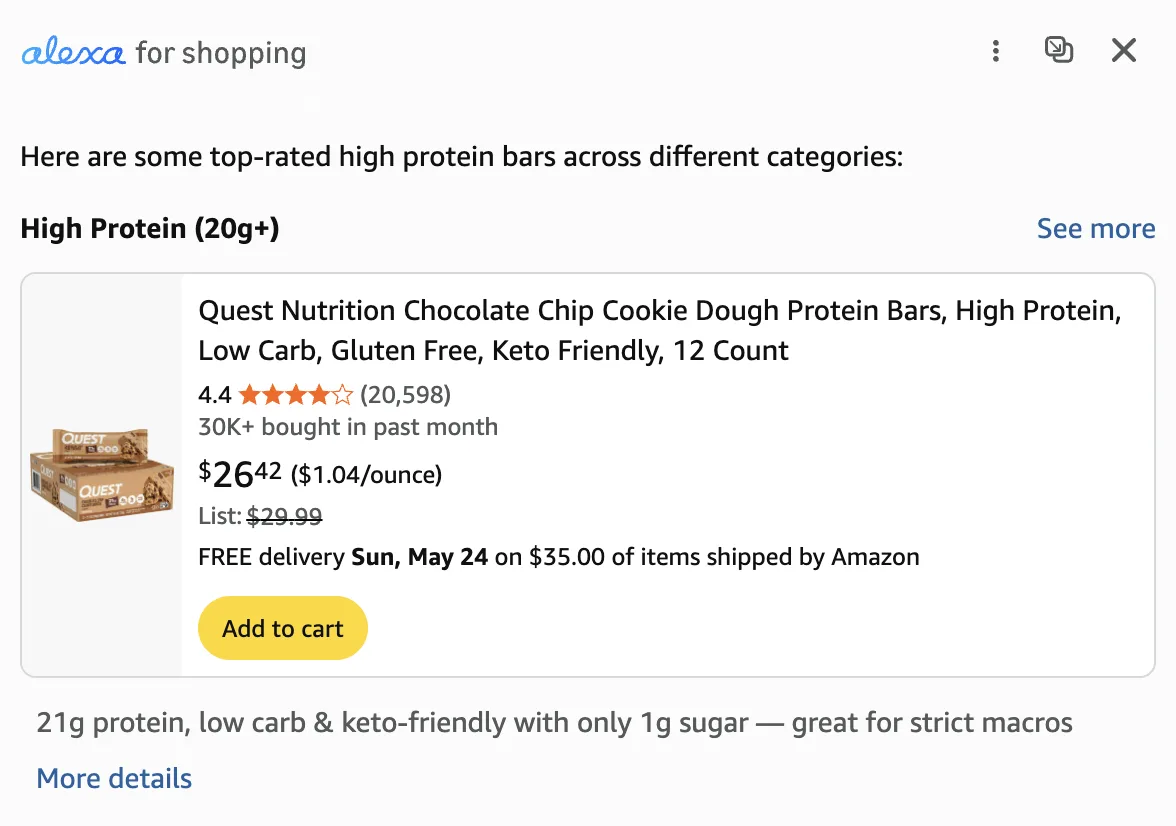
Per CNBC's coverage, Daniel Rausch, Amazon's top Alexa executive, confirmed Alexa for Shopping will feature ads where they enhance the shopping experience, and active Sponsored Products campaigns are already auto-eligible to surface inside Alexa for Shopping conversations. CNBC
What is Alexa for Shopping, and how is it different from Rufus?
Alexa for Shopping is a unified AI shopping assistant that combines Rufus's product expertise with Alexa+'s personalization and cross-device memory. Rufus is no longer a separate brand. Its capabilities now live under the Alexa for Shopping name across every Amazon surface.
The mechanical change matters more than the rebrand. Rufus was a chat panel inside Amazon's shopping surfaces. Alexa for Shopping is a cross-surface agent that shares memory, preferences, and purchase history across every device a shopper uses. As Rajiv Mehta, Amazon's vice president of conversational shopping, framed it to Axios, the experience is designed to follow customers from device to device, so a voice query on an Echo Show and a typed prompt in the app are treated as one continuous session. Axios
The unified system also brings new capabilities: 365-day price history on hundreds of millions of products, dynamic product comparisons from search results, AI overviews at the top of search and product pages, automated cart-building from past orders, scheduled price-triggered purchases, and Buy for Me checkouts on third-party retailer sites.
What does Patent US 12,141,529 actually describe?
The patent describes a system that lets a voice assistant answer broad product questions by analyzing attributes across multiple listings, rather than matching keywords against any one listing. The patent was authored by members of the same Rufus team and was granted before the Alexa for Shopping launch.
The shift the patent encodes is structural. Traditional Amazon search ranks listings against a keyword query. The patent's system reads the same query as a request for an aggregated answer, then constructs that answer from across the catalog. The example Andrew Bell highlighted in his Forbes-covered analysis: when asked "Do jeans shrink after washing?", the system can respond "Based on 32 jeans, most (87%) shrink slightly after washing," and then suggest relevant products. A similar pattern handles "Can I put plastic plates in the dishwasher?": the system reports how many qualifying products in its index say yes versus no. Retail Media Breakfast Club
This is not a chatbot bolted onto search. It is a different way of reading the catalog.
How does the 3-stage discovery system work in practice?
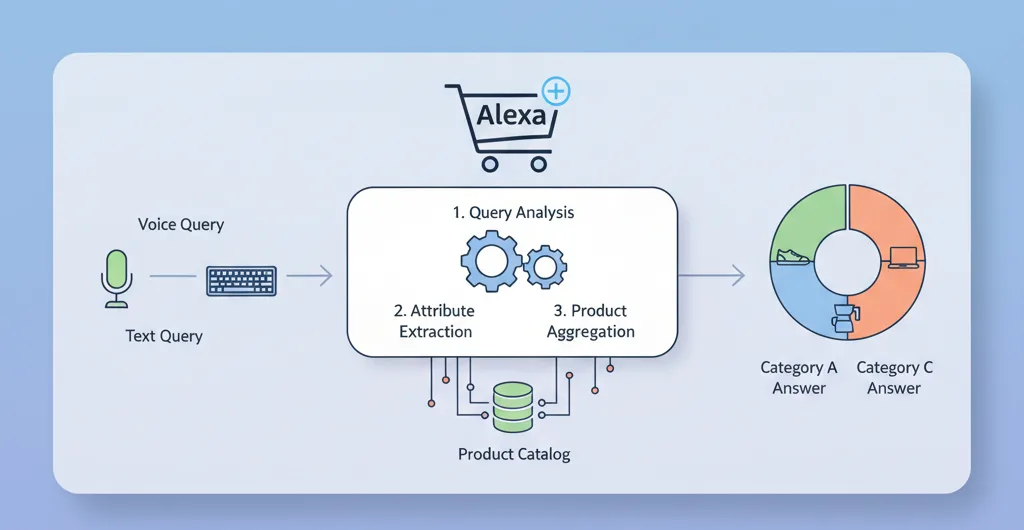
The patent describes three stages: query processing, data collection and analysis, and answer generation. Stage 1 extracts product categories and attributes from a shopper's question using named entity recognition. Stage 2 finds relevant products and ranks which attributes are most material to the question. Stage 3 aggregates the data and uses templates to produce a natural conversational response.
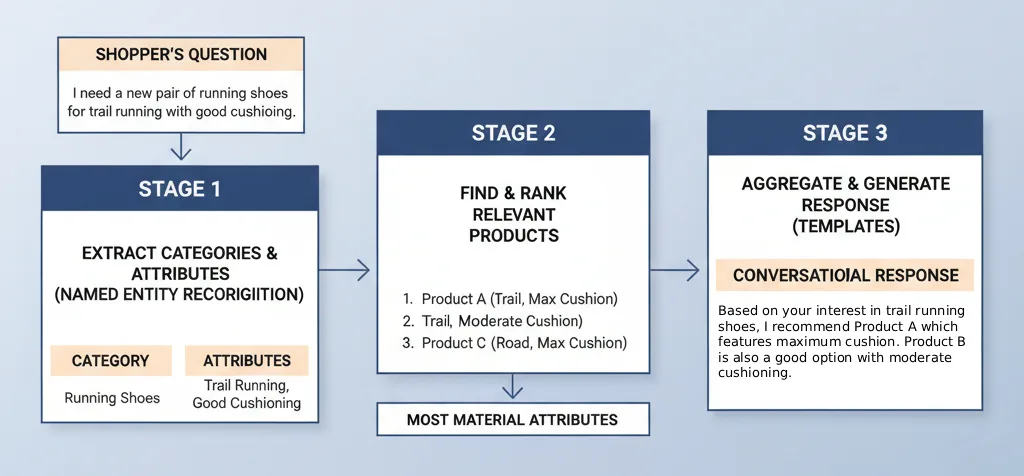
The table below shows each stage, what data it pulls from, and what the seller-side implication is.
|
Stage |
What it does |
What data it reads |
Seller-side implication |
|
1. Query Processing |
Identifies product categories and attributes in the shopper's question |
Named entity recognition on natural-language input (voice or typed) |
Your listing must surface category and attribute signals clearly enough to be classified into the right pool |
|
2. Data Collection & Analysis |
Finds relevant products and ranks the attributes most material to the question |
Title, bullets, A+ structured fields, reviews, Q&A, attribute metadata across many listings |
Attribute density across the listing now affects whether your SKU is cited in aggregate answers, not only whether it ranks for one keyword |
|
3. Answer Generation |
Aggregates data across listings and uses templates to produce a conversational response |
Aggregated attributes from Stage 2, plus personalization signals (history, preferences, household context) |
Listings with missing or ambiguous attributes get summarized out of the answer, even when they would have ranked under a keyword search |
The personalization layer in Stage 3 is part of the patent's design, not an afterthought. The system incorporates a shopper's historical transactions, items added to cart, purchase rates, and related searches when determining which products to include in responses. Two shoppers asking the same question can receive different product surfacings. Retail Media Breakfast Club
Why does this change how your products get discovered?
Under the keyword era, a listing competed against other listings for a single ranking position when a buyer searched a specific phrase. Under the patent's architecture, the same listing contributes data to every aggregate answer in its category. Attribute density across the listing now affects whether the SKU is cited at all when a shopper asks a category-level question.
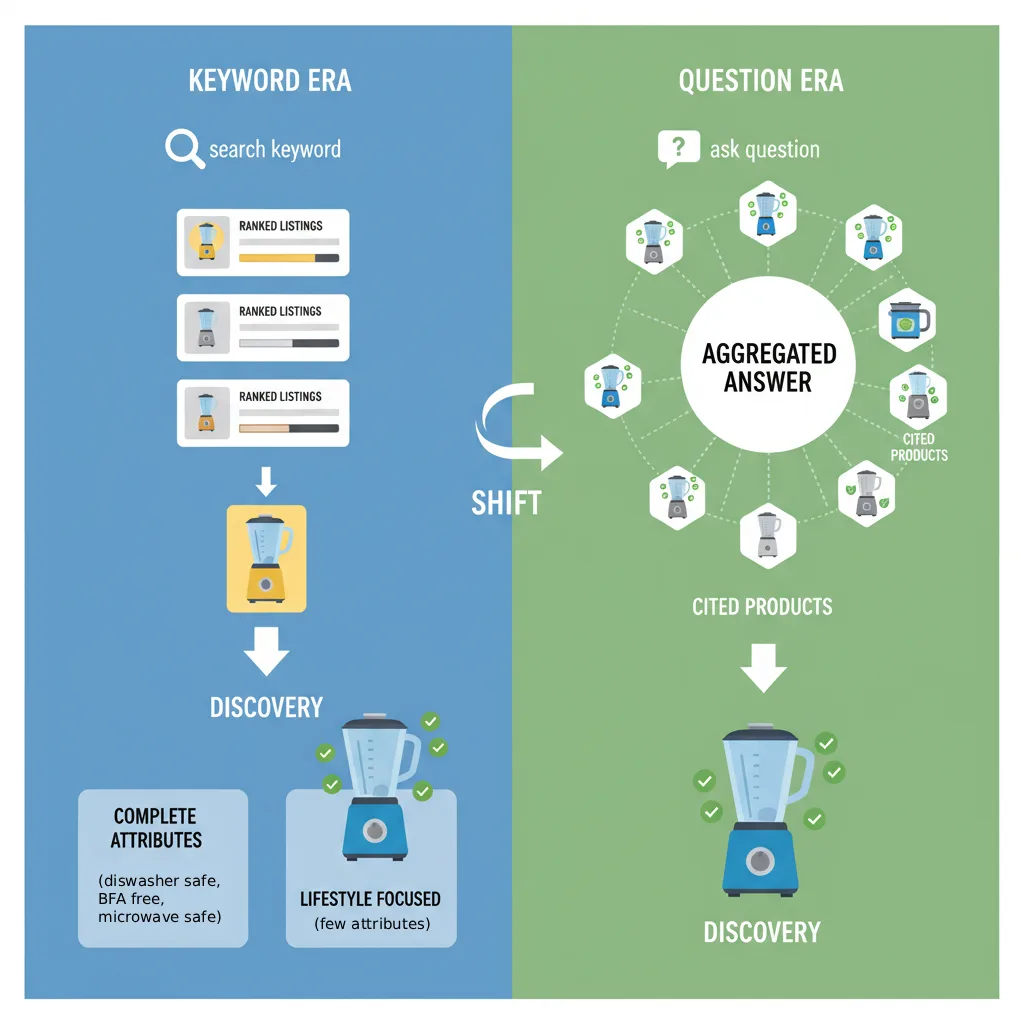
A kitchen brand with two near-identical SKUs, where one has complete attribute density on dishwasher safety, BPA status, and microwave compatibility, and the other has bullets focused on lifestyle imagery. The completeness gap shows up in how Alexa for Shopping surfaces them when shoppers ask category-level safety questions.
The downstream effect is that the cost of attribute gaps is now compounding. A listing that omits a relevant attribute is invisible not just to the one query that attribute would have matched, but to every aggregate question that pools attributes across the category.
"Most listing audits still grade for keyword density and bullet structure. We are starting to grade for attribute completeness across the dimensions a category-level Alexa for Shopping question would aggregate. The listings that hold up are the ones that read like reference material on the product, not marketing copy about it." — Stefano Bettani, Marketing Evolution Analyst, Amazify
What does this mean for Sponsored Products and PPC?
Sponsored Products is being woven into the new surface, but with limited reporting visibility for now. Per CNBC's reporting, Daniel Rausch, Amazon's top Alexa executive, said the assistant will feature ads where they enhance the shopping experience and expose additional products depending on where a shopper is in the journey. Active Sponsored Products campaigns are auto-eligible to appear inside Alexa for Shopping conversations with no separate opt-in or dedicated bidding control yet. CNBC
Two operational consequences follow.
First, voice, chat, and click conversions now collapse into one cross-device session, so existing PPC dashboards under-report assisted sales until Amazon Ads ships placement-level breakdowns for Alexa for Shopping. A spike in unattributed orders for a flagship ASIN over the next quarter likely reflects agentic discovery, not a measurement bug.
Second, branded-term ACoS deserves close watch over the next four to six weeks. Per Andy Jassy on Amazon's earnings call, AI interfaces create multiple opportunities to surface products, both organically and as sponsored placements, which means the discovery mix on branded queries is shifting. If your branded-term ACoS drifts up or down by more than 10 to 15% with no campaign changes, that is the surface mix moving. Modern Retail
What should FBA sellers do about it now?
Six tactical moves for the next 30 days.
-
Audit attribute density on flagship ASINs. Walk your top 10 ASINs against the category-level questions a shopper might ask Alexa for Shopping. If your listing cannot answer "is it dishwasher safe," "what household sizes does it fit," or "does it pair with X," the attribute is missing from the listing, not just from your buyers' minds.
-
Rebuild bullets for completeness over polish. Add specific compatibility statements, safety statements, and use-case statements, even when they feel redundant. Reference-grade attribute coverage beats marketing-grade copy under aggregation.
-
Stress-test your listings on the actual surface. Run three category-level voice queries on an Echo Show or in the Alexa for Shopping panel, against your top SKU and a competitor's. Note which listing the system cites and what attributes it pulls from.
-
Build a "direct or unattributed" segment in your PPC reporting. Isolate agent-driven orders so you can track the ramp as voice and chat surfaces scale. This is the early signal that conversion is moving away from the search results page.
-
Lock SKU-level contribution margin before agentic price triggers scale. Auto-buy and target-price triggers fire at the buyer's threshold, not the seller's. Sellers without a clean margin floor will discover it via stockouts and unprofitable orders.
-
Watch branded-term ACoS weekly. A 10 to 15% drift with no campaign changes signals that the surface mix on branded queries has moved.
What are the limits of reading this patent?
Patent US 12,141,529 is not the technical blueprint for Alexa for Shopping itself. The live experience still resembles Rufus, with the same conversational interface, the same data sources, and COSMO doing the semantic heavy lifting underneath. The patent shows where Amazon has been investing architecturally. It does not document what shipped on May 13 line by line. Azoma
This matters for sellers in one specific way: do not over-rebuild your entire content strategy from one patent. The patent confirms a direction Amazon is moving toward. The COSMO research that has been on the record for longer remains the live operating system. Build for both at once.
Ready to grade your listings for Alexa for Shopping aggregation, not just keyword rank?
Frequently Asked Questions
Alexa for Shopping is Amazon's unified AI shopping assistant, launched May 13, 2026, that merges the product expertise of Rufus with the personalization layer of Alexa+. It runs across the Amazon Shopping app, Amazon.com, Echo Show devices, Alexa.com, and the Alexa app. A Prime membership is not required.
Amazon announced the launch on May 13, 2026, with a rollout to U.S. customers over the following week. The launch consolidates Rufus, which Amazon launched in 2024, and Alexa+, which became free for Prime members in February 2026.
The patent describes a system that answers broad product questions by analyzing attributes across many listings at once. It outlines a three-stage process: named entity recognition on the query, attribute aggregation across relevant listings, and templated conversational answer generation. It was granted to members of the team that built Rufus.
Yes. Personalization is a core design element of the patent and the live system. Alexa for Shopping incorporates a shopper's purchase history, items added to cart, browsing patterns, conversations across devices, and stated preferences when generating an answer. Two shoppers asking the same question can receive different product surfacings.
Active Sponsored Products campaigns are auto-eligible to surface inside Alexa for Shopping conversations with no separate opt-in. Amazon Ads has not yet shipped a dedicated bidding control or a placement-level reporting line item for Alexa for Shopping, so impressions and spend currently roll into standard Sponsored Products campaign data.
No. The standalone Rufus chatbot is being discontinued, and the Rufus brand has been replaced by Alexa for Shopping across Amazon's app and website. Amazon has confirmed that Rufus's recommendation features and shopping history continue to inform Alexa for Shopping responses.
Search ranked listings against keywords. Alexa for Shopping reads them as evidence.
Ready to stop leaving money on the table?
Get a free margin audit and see exactly how much profit you're missing.
Book Your Free Audit →