AI Amazon Listing Images in 2026: Where the Tools Stand and What Still Misses
 May 21, 2026
 The AI image generation category has moved from novelty to production tool in under twelve months. Google released Nano Banana Pro on November 20, 2025. OpenAI launched GPT Image 2 on April 21, 2026. Amazon's own AI Creative Studio is now embedded inside Seller Central and Amazon Ads. A growing set of purpose-built platforms, such as Scalable, Ecomtent, Nightjar, Claid.ai, Photoroom, and Pebblely, has layered Amazon-specific workflows on top of the foundation models. Sellers can now generate full image sets without a photographer, a studio, or a designer.
The capability is real. What's less clear is how much of what gets generated actually performs on Amazon. This piece walks the current landscape, where each tier of tooling fits, and what an Amazon-specific image system has to do that a general-purpose foundation model alone cannot.
Amazon listing images live under tighter constraints than almost any other commerce visual asset. They have to pass image compliance, render correctly at thumbnail size on mobile, communicate the product benefit in under two seconds, and increasingly feed an AI discovery layer that reads them differently than a human shopper does. The tools are catching up to part of that. The piece below is an honest evaluation of where they sit and what's still missing.

Key Takeaways
-
The current state-of-the-art image models (Nano Banana Pro and GPT Image 2) hit a quality bar that was unreachable in 2024, and both are accessible via API and inside ChatGPT, Gemini, n8n workflows, and other downstream tools.
-
Amazon's free AI Creative Studio is a useful starting tier for lifestyle backgrounds and ad creative variations. Amazon Ads reported in 2023 that Sponsored Brands mobile ads with lifestyle imagery saw CTRs 40% higher than ads with standard product images.
-
Amazon's own subsequent reporting (AWS, May 2025) found advertisers using AI-generated images in Sponsored Brands hit roughly 8% absolute CTR and submitted 88% more campaigns than non-users. Both figures come from Amazon, not independent measurement. Treat as directional, not proof.
-
Purpose-built platforms (Scalable, Ecomtent, Nightjar, Claid.ai, Photoroom, Pebblely, and others) add Amazon-specific workflows on top of the foundation models. The category is advancing.
-
Despite the capability jump, most AI-generated Amazon images still miss on mobile rendering, feature and benefit accuracy, deep review and competitor harvest, and alignment with how Rufus and COSMO interpret listing content.
-
If you go on LinkedIn, the "AI influencer" prompt-as-lead-magnet pattern often shows polished one-off outputs that don't reproduce at production scale across a real catalog.
-
The next layer of value is not the model. It is the Amazon-specific operator logic wrapped around it: conversion psychology, mobile-first composition, Rufus and COSMO alignment, and consistent output across hundreds of ASINs.
Why is AI image generation suddenly a real production option for Amazon sellers in 2026?
Because two model releases inside six months closed the quality gap that kept AI images off most professional Amazon listings. Nano Banana Pro and GPT Image 2 both render text correctly, handle photorealistic product detail, and produce outputs at resolutions that meet Amazon's image requirements without obvious AI artifacts.
The earlier generation of image models had a consistent failure profile: warped product geometry, garbled text inside the image, low-resolution detail that blurred under Amazon's zoom feature, and lighting that did not match a real studio shot. Most sellers who tested those models in 2024 concluded that AI-generated images were good enough for ad creative variations but not for the hero image on a listing.

That has changed. Nano Banana Pro renders at up to 4K resolution with accurate text and multilingual support, identity preservation across up to five subjects, and fine-grained control over lighting, camera, and focus. GPT Image 2 added a reasoning mode that lets the model plan a layout, search the web for reference material, and self-check outputs before delivering the image. Both models are accessible via direct API, inside ChatGPT and Gemini, and through workflow tools like n8n, Make, and Zapier.
The result is that any seller with access to a credit card and a prompt can now generate a passable lifestyle product image in under a minute. The capability is no longer the bottleneck.
What can foundation models like Nano Banana Pro and GPT Image 2 actually do for Amazon images, and where do they fall short?
They can produce a single high-quality image from a well-crafted prompt. They cannot, on their own, produce a strategically optimized Amazon image set without significant operator input on top.
Direct API use via Google AI Studio or OpenAI's image API gives developers the most direct access. ChatGPT and Gemini's consumer interfaces provide a conversational workflow for non-technical users. n8n and similar tools chain prompts and model calls into automation pipelines that can process multiple products in a batch. Each entry point hits the same foundation model under the hood. The output quality is largely a function of the prompt and the reference inputs.
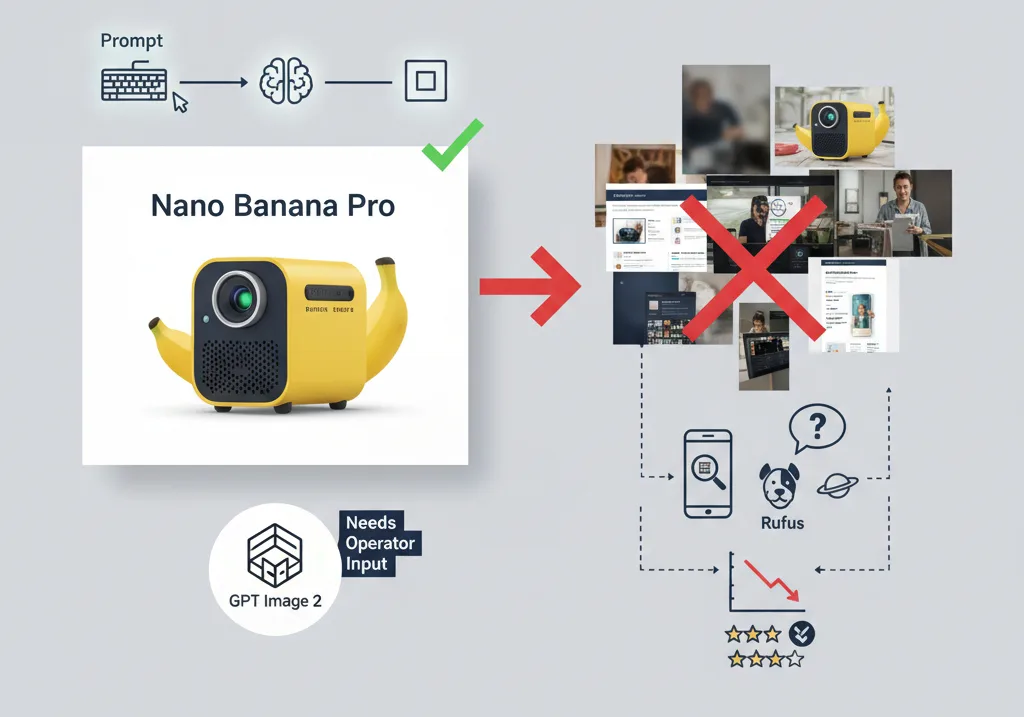
The shortfall is not in the model. It is in what the model does not know. A foundation model does not natively understand Amazon's image compliance rules, the mobile thumbnail rendering test, the conversion behavior of a hero image versus a lifestyle image versus an infographic, or how Rufus and COSMO interpret what they see. It does not harvest a brand's customer reviews to surface the features that matter to buyers in that category. It does not know what the top three competitors in the same subcategory are doing. It treats each image as an isolated creative task.
The "AI influencer" pattern, which sells prompts and workflows as lead magnets, sits within this gap. The single hero image that wins LinkedIn engagement was usually selected from many attempts, with the failed attempts cropped out of the post. In real production, across a real catalog of 50 or 200 ASINs, the variance is much wider, and the editing burden is significant.
How does Amazon's native AI Creative Studio fit into the stack?
Amazon AI Creative Studio is the free entry tier. It generates lifestyle backgrounds, ad creative variations, and Sponsored Brands imagery directly in the Amazon Ads console, using the product image as input. For sellers running paid campaigns who need fast creative variations on a tight budget, it is the obvious first stop.
Reported performance data from Amazon's own announcements is meaningful but uneven in age and methodology. Amazon Ads' 2023 launch coverage of the original image generator reported that products shown in lifestyle contexts in Sponsored Brands mobile ads saw CTRs around 40% higher than ads using standard white-background product shots. A later AWS Machine Learning Blog post in May 2025 reported that advertisers using AI-generated images in Sponsored Brands hit nearly 8% absolute click-through rates and submitted 88% more campaigns than non-users. Both numbers come from Amazon, and the 8% figure is an absolute CTR, not a lift over non-AI creative. They are useful as directional signals that lifestyle and AI-generated imagery move the needle on Sponsored Brands. They are not independent proof.
Where the tool stops: hero image generation for organic product detail pages, deep customization for niche or premium categories, multi-asset A+ Content modules, and image sets that need to coordinate across a multi-product brand store. Sellers using Creative Studio typically pair it with another solution for those use cases.
What do purpose-built Amazon image platforms add?
The most mature platforms in this category layer Amazon-specific workflows, data inputs, and brand consistency tools on top of the foundation models. Scalable, for example, generates a full set of listing images from an ASIN input, analyzes customer reviews and product features as part of the brief, and is explicit about positioning itself against generic AI image tools with the framing that "Gemini can generate stunning images. But it has no idea what converts on Amazon." Ecomtent focuses on AI photo shoots and A+ Content generation, with conversion optimization built in. Nightjar targets the catalog-consistency problem, generating at 2048x2048 natively, preserving product identity across hundreds of SKUs, and enforcing Amazon's pure white background and frame fill rules in its standard workflow. Claid.ai bridges the gap between clean catalog requirements and creative lifestyle work, with background normalization, upscaling, and physics-aware scene generation. Photoroom, used by over 150 million sellers per its own reporting and consistently rated by third-party reviewers as a strong tool for fast background removal and mobile-first product editing, brings editing, staging, and generation into one workflow. Pebblely sits at the lighter end of the spectrum, with one-click pre-themed lifestyle backgrounds for sellers who want quick variations without learning a workflow.
These platforms are genuinely advancing the category. The best of them solve the most frustrating part of working with foundation models directly: the lack of Amazon-specific context inside the generation process itself.
The evaluation criteria that matter when comparing them include:
|
Criterion |
What to look for |
|---|---|
|
Input requirement |
Does the platform require uploaded reference images, or can it work with an ASIN or URL alone? |
|
Data harvest |
Does it automatically pull customer reviews, competitor positioning, and category benchmarks into the prompt? |
|
Mobile optimization |
Is the output tested and optimized for mobile thumbnail rendering, where most Amazon purchases happen? |
|
Compliance |
Does it enforce Amazon's image policies (white background main image, 1000px minimum, product fills 85% of frame)? |
|
Catalog scale |
Can the same prompt logic apply across hundreds of ASINs without per-image retuning? |
|
Rufus and COSMO alignment |
Does the image set support how Amazon's AI discovery layer reads and ranks listings? |
The honest assessment is that the category has come a long way, and the leading platforms have closed most of the obvious gaps. Where they vary is in how deep the Amazon-specific layer goes and how well the output holds up when applied across a real catalog at production scale.
What is the best AI tool to generate Amazon product images and lifestyle photos?
There is no single best tool. The right choice depends on whether you need free ad creative variations, catalog-scale listing images, or full ASIN-to-image automation with Amazon-specific data baked in.
The honest landscape, segmented by use case:
|
Use case |
Best tier |
Examples |
|---|---|---|
|
Free ad creative variations inside Amazon Ads |
Amazon's native option |
Amazon AI Creative Studio |
|
Catalog-scale consistency across hundreds of SKUs |
Purpose-built e-commerce platforms |
Nightjar, Claid.ai |
|
Background removal and mobile-first quick edits |
Lightweight e-commerce tools |
Photoroom, Pebblely |
|
Full listing image set generated from ASIN input with review harvest |
ASIN-native Amazon platforms |
Scalable, Ecomtent |
|
Direct API access for custom workflows |
Foundation models |
Nano Banana Pro (Gemini 3 Pro Image), GPT Image 2 |
|
Amazon-specific operator logic embedded in prompt and agent layer with cross-category consistency |
Specialized closed-beta solutions |
Amazify (closed beta) |
Most production catalogs benefit from a stack, not a single tool. A typical mid-market FBA brand might use Amazon AI Creative Studio for Sponsored Brands variations, Nightjar or Claid.ai for catalog-consistent secondary images, and a specialized Amazon-aware system for hero image and A+ Content generation where Rufus and COSMO alignment matters most.
Why do most AI-generated Amazon images still miss the conversion mark?
Because Amazon image performance is governed by a set of conditions that exist outside the image itself. The model can produce a beautiful product render. Whether that render performs on Amazon is a separate question.
Four conditions account for most of the miss:
Mobile-first rendering. A majority of Amazon purchases now happen on mobile devices. An image that looks compelling on a 27-inch monitor often loses critical detail at the thumbnail size on a phone screen. Tools that generate at desktop-default proportions and resolutions don't test for the mobile failure mode where the hero product becomes indistinguishable from the background.
Feature and benefit accuracy. A product page has to surface the specific features that matter to buyers in that category. A foundation model with no listing or review data will generate a generic lifestyle scene that may not communicate the dimensional accuracy, material texture, scale relative to the body or hand, or use-case context that drives conversion. The image looks polished. It does not sell the product.
Customer review and competitor harvest. The buyer pain points that drive conversion are usually visible in customer reviews of the product and its competitors. An image generated without that data may emphasize the wrong attribute. A pet supplement that wins on "no fishy smell" needs that benefit visible in the image set. A foundation model not given that input will produce a generic supplement-bottle shot.
Rufus and COSMO alignment. Amazon's AI discovery layer reads images differently than a human shopper does. Rufus and the COSMO ranking system increasingly process listing content as input to natural-language buyer queries. Images that don't reinforce the listing's question-answering capacity get less algorithmic lift than images that do. Most general-purpose AI tools have no awareness of this layer.
"The model is not the bottleneck anymore. The operator logic wrapped around the model is what determines whether the image converts. Most of what we see in the wild is a great prompt applied to a great model with no Amazon-specific layer between the two." Stefano Bettani, Head of Operations, Amazify
What does an Amazon-specialized image system have to do that a foundation model alone cannot?
It has to embed the Amazon operator logic into the prompt layer and the agent layer before the foundation model ever runs. The model becomes the rendering engine. The intelligence sits in what gets fed to it.
The components that matter:
-
ASIN-only input. A production system should take an Amazon URL or ASIN as the single input and pull product attributes, customer reviews, A+ Content, and category context automatically. Requiring users to upload reference images limits scale and introduces variance.
-
Mobile-optimized composition rules. The system should generate at proportions and resolutions tested against the mobile thumbnail view, where the conversion happens.
-
Conversion psychology embedded in the prompt. The system should encode the emotional and rational buying criteria that drive Amazon purchases: trust signals, scale references, dimensional accuracy, lifestyle context that matches buyer demographics, and category-specific buying patterns.
-
Customer review and competitor harvest. The system should pull from review data, competitor listings, and category benchmarks to ensure the image set communicates the features and benefits that matter to that buyer.
-
Rufus and COSMO alignment. The image set should support how Amazon's AI discovery layer reads listings, with composition and imagery that reinforce question-answering capacity.
-
Cross-category generalization. The same system should work for kitchen gadgets, supplements, apparel, electronics, home goods, and outdoor equipment without per-category retuning.
-
Cost and speed at scale. The system should produce a full image set per ASIN at a fraction of the cost of an agency or studio shoot, with consistent output across hundreds of ASINs.
This is the layer most AI image tools either don't have or have only partially. It is also the layer that determines whether the output performs on Amazon or just looks polished.
A note on Amazify's approach
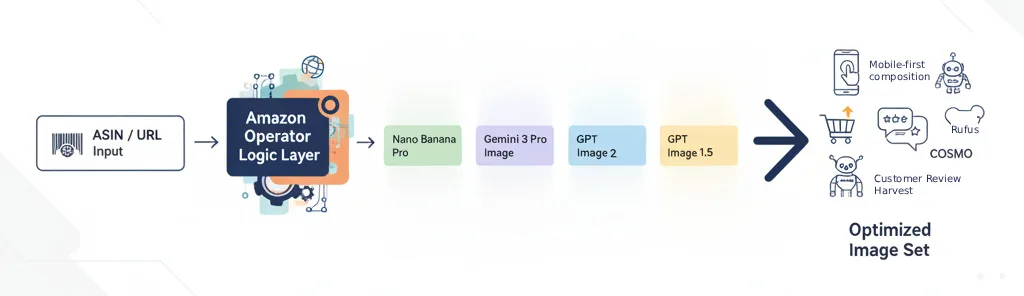
Amazify has built a closed-beta image generation system that uses the latest foundation models (Nano Banana Pro / Gemini 3 Pro Image, GPT Image 2, GPT Image 1.5, and Gemini 2.5 Flash Image) as the rendering layer, with an Amazon-specific operator logic layer between the ASIN input and the model output. The system takes a single ASIN or Amazon URL as input, requires no reference images, and produces a full optimized image set with the mobile-first composition, conversion psychology, customer review harvest, and Rufus and COSMO alignment described above already embedded in the prompt and agent architecture.
Example image set 1 - MAIN HERO IMAGE

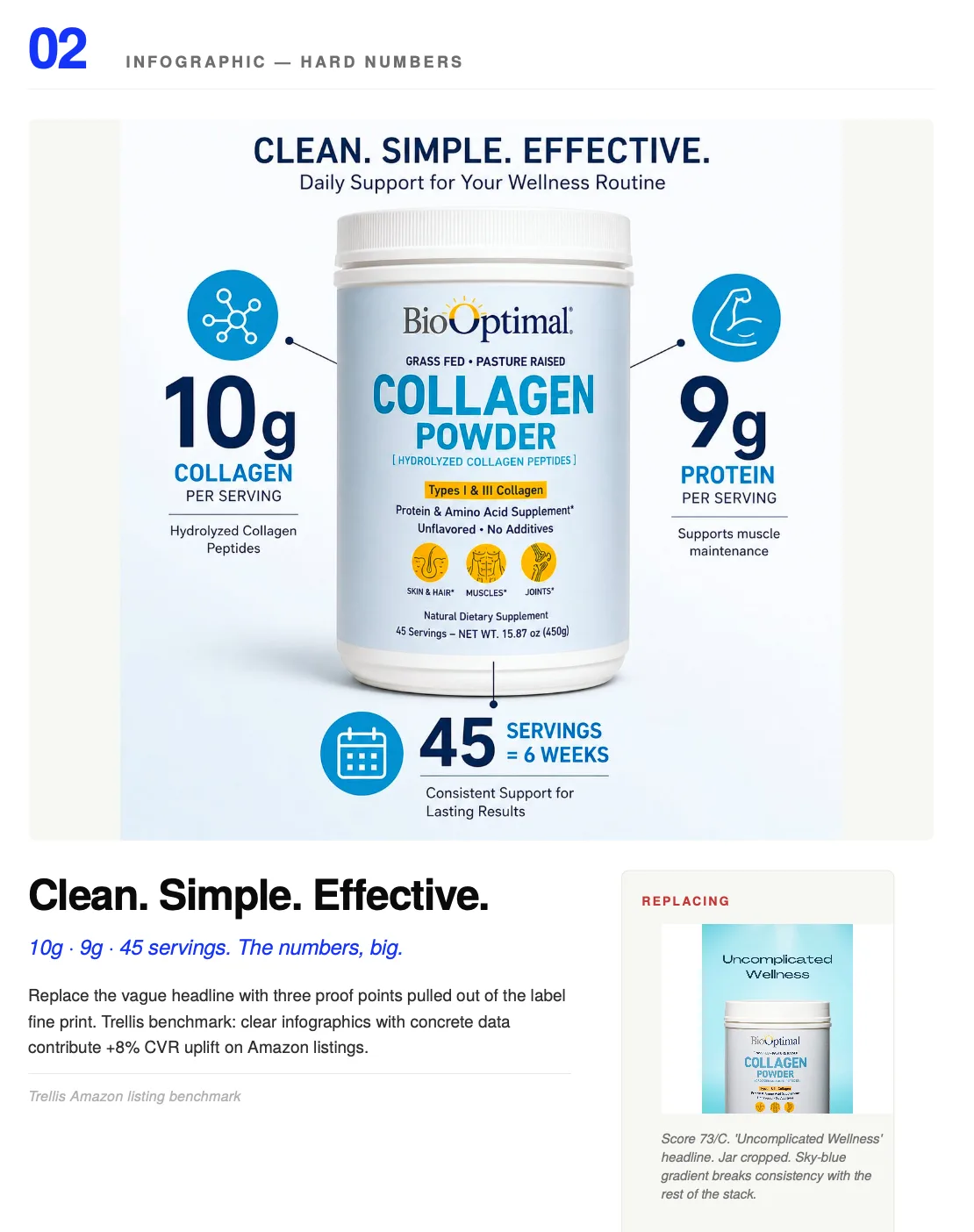
Example image set 2 - INFOGRAPHIC IMAGE
The system is currently in closed beta and private invite only. Brands interested in early access can reach out via the Amazify contact page.
Frequently Asked Questions
The honest answer is that the best choice depends on the use case. For free ad creative variations inside Amazon Ads, Amazon's AI Creative Studio is the default starting point. For catalog-scale consistency across hundreds of SKUs, Nightjar and Claid.ai are the leading options. For fast background removal and mobile-first edits, Photoroom and Pebblely are widely used. For full listing image sets generated from an ASIN with customer review harvest, purpose-built platforms like Scalable and Ecomtent are the most mature options. For brands that want Amazon-specific operator logic embedded in the prompt layer with cross-category consistency at catalog scale, specialized solutions like Amazify's closed-beta system are emerging. Foundation models like Nano Banana Pro and GPT Image 2 are the underlying engines but require significant operator input to produce listing-grade output directly.
Yes, both ChatGPT (running GPT Image 2) and Gemini (running Nano Banana Pro) can generate high-quality product images from a prompt. The limitation is that neither has native awareness of Amazon's image compliance rules, mobile thumbnail rendering requirements, customer review data, competitor positioning, or Rufus and COSMO ranking signals. Sellers using direct foundation model access typically have to build that operator logic into their own prompts and workflows, or run significant manual review on the output.
Yes. Amazon does not prohibit AI-generated images, and Amazon's own AI Creative Studio actively generates them for Sponsored Brands and Brand Stores. The compliance requirements that apply to any Amazon image still apply: hero images need a pure white background (RGB 255,255,255), a minimum 1000 pixels on the longest side, and the product filling at least 85% of the image frame. AI-generated images that meet these rules are accepted. AI-generated images that violate them risk listing suppression like any other non-compliant image.
Foundation model API costs are typically a few cents per image at standard resolution. Purpose-built platforms range from low-monthly-subscription pricing to per-image pricing in the dollars range, with effective per-image costs around $0.05 to $0.25 at catalog scale. Amazon's AI Creative Studio is free to use inside the Amazon Ads console. A traditional studio photo shoot for an Amazon product set typically ranges from several hundred to several thousand dollars per ASIN depending on complexity. The cost differential is significant enough that the question for most sellers is no longer whether to use AI but which AI tool to use for which part of the image set.
The polished one-off outputs that circulate on social media are usually the best frame from many attempts, often with manual editing on top. In real production across a catalog of multiple ASINs, the variance is much wider, the failure modes are more visible, and the editing burden is meaningful. The gap between a hero example and consistent production output is one of the most common reasons sellers report AI fatigue with image generation tools.
Yes, but the maturity varies by tool. Ecomtent and Scalable focus directly on A+ Content generation with conversion optimization built in. Nightjar and Claid.ai handle infographic-style overlays and structured comparison modules at catalog scale. Foundation models like GPT Image 2 with its reasoning mode can produce A+ Content modules from a well-crafted prompt, but the layout consistency across a multi-module storefront usually requires either operator post-editing or a purpose-built A+ Content tool that enforces module-level brand consistency.
Not entirely, but the role is shifting. Hero images for premium or specialty categories where physical material accuracy, brand storytelling, and human models matter still benefit from traditional photography. Volume image generation across mid-market FBA catalogs, ad creative variations, lifestyle background swaps, infographic generation, and A+ Content modules are increasingly moving to AI tools. The category that's emerging is hybrid: photographer-captured hero assets combined with AI-generated lifestyle, infographic, and ad creative variations at scale.
Ready to stop leaving money on the table?
Get a free margin audit and see exactly how much profit you're missing.
Book Your Free Audit →