How Amazon’s COSMO Algorithm Profiles Your Buyer (2026 Seller Guide)
 Jun 16, 2026
 Amazon spent the spring publishing pieces of its own discovery playbook, and most sellers read them as consumer news. On May 13, 2026 it launched About You, a feature that opens up and shows a shopper the profile Amazon has built on them. In the same window, Amazon’s research team published a paper on training personalization models with synthetic data. On their own, each looks routine. Read together, they show how Amazon decides which product to put in front of which buyer, and that is something you can optimize for.
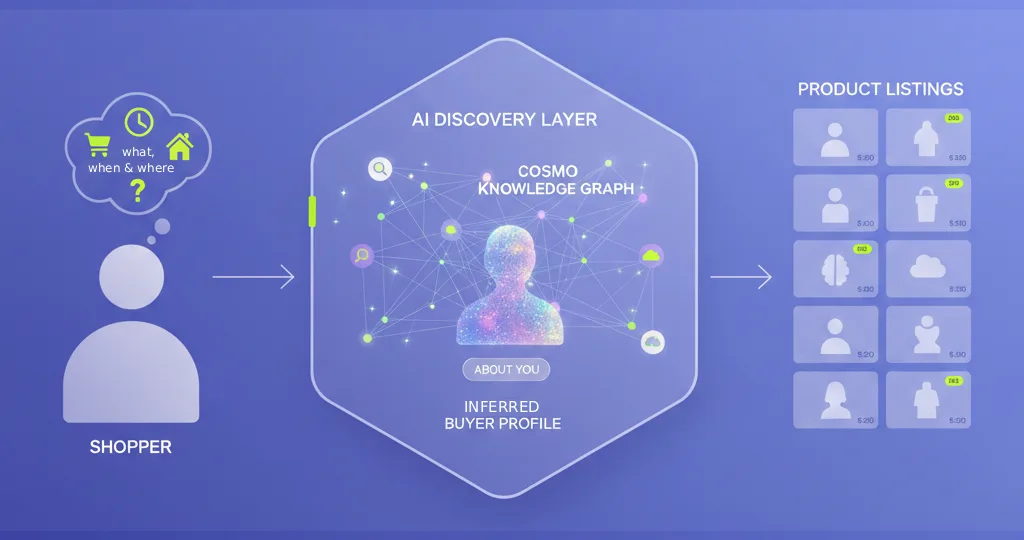
Amazon’s discovery layer no longer matches your keywords to a shopper’s query. It matches your product against an inferred model of who the shopper is, what they need, and the context they need it in, built by systems like the COSMO knowledge graph and surfaced to shoppers in the new About You feature. Two pieces of Amazon’s own public work, the COSMO research and a 2026 paper on synthetic user personas, show the shape of that model clearly enough to optimize against it: your listing’s job now is to answer the who, what, when, and where questions the model asks, not just to carry the keywords the old search index counted.
Key Takeaways
-
COSMO is the commonsense knowledge graph Amazon uses to connect products to human context, the audience, function, occasion, and location behind a purchase, through typed relations like used_for_audience, not just factual attributes like brand, size, and color (per Amazon Science).
-
About You, launched May 13, 2026, lets a shopper open the profile Amazon has built on them and edit it. The signals Amazon names are purchase history, conversations with Alexa for Shopping, product reviews, Lists, and searches.
-
A 2026 Amazon Science paper shows Amazon training interest-inference models on Comprehensive Synthetic Personas, fabricated user profiles that, in Amazon’s own testing, beat real de-identified data on precision and recall. The inference layer is a funded, deliberate build.
-
Read together, these are Amazify’s read of a public blueprint: Amazon resolves a search by matching your product to an inferred needs profile, then ranks on how well the match holds.
-
The optimization move is to write the implicit questions COSMO encodes into your titles, bullets, description, images, and A+ content: who the product is for, what it does, when and where it is used, and what problem it solves.
-
Keyword coverage still matters for retrieval, but it is the floor. The listings that get surfaced answer the buyer’s inferred intent, not just the buyer’s typed string.
Why doesn’t keyword matching explain Amazon search anymore?
Because Amazon stopped relying on a pure keyword index years ago and layered an intent-understanding system on top of it. The old A9 model matched the words in a query to the words in your listing; the current stack works out why someone is searching and which product actually solves that.
For a seller, the practical effect is that a listing packed with the right keywords can still lose to a thinner listing that answers the buyer’s real question. A query like “gift for a coworker who loves coffee” has almost no keyword overlap with most product titles. The system has to infer that a pour-over kit fits a gifting occasion and a coffee-lover audience before your product can surface at all.
What is the Amazon COSMO algorithm actually doing?
COSMO is a knowledge graph that encodes commonsense relationships between products and the human contexts they belong to: the audiences, functions, and locations behind a purchase. Amazon’s research team built it to close the gap between how a search index reads a product and how a person thinks about buying one.
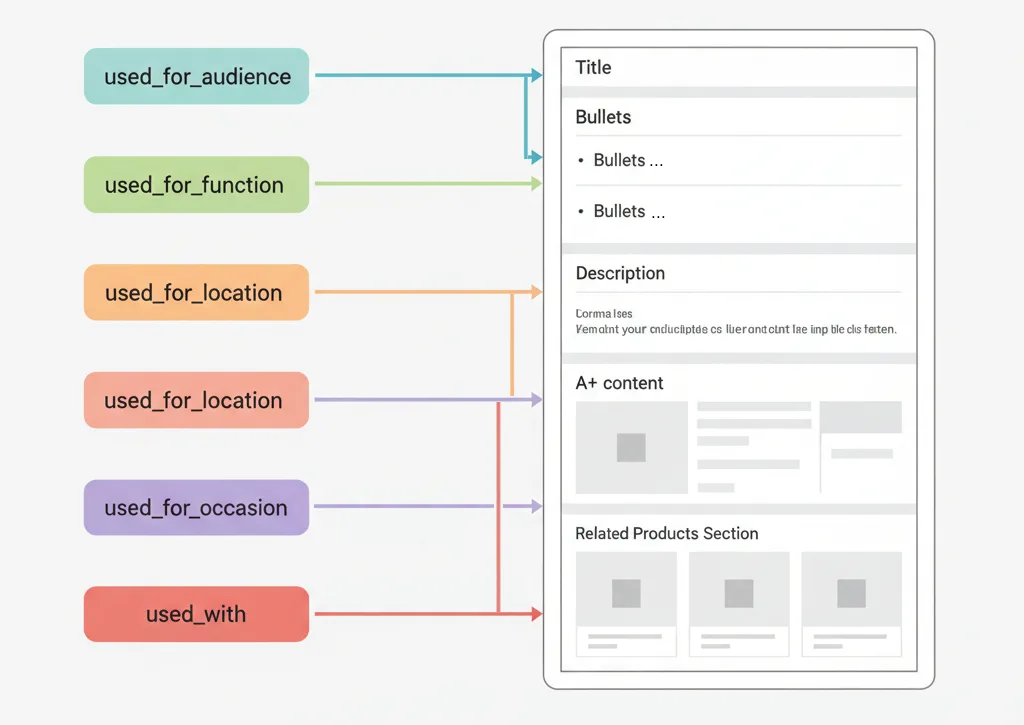
Amazon’s published description walks through the construction. The system starts from query-purchase and co-purchase data, prompts a large language model to generate commonsense explanations for that behavior, then filters the output with human annotation and machine learning. The result is a set of relationships such as used_for_audience, which links slip-resistant shoes to pregnant women, or capableOf, which links a camera case to protecting a camera.
Amazon documents the audience, function, and location relations directly; the occasion and used-with rows below extend the same family and are illustrative. The mapping a seller cares about is the second and third columns.
|
COSMO-style relation |
The buyer question behind it |
Listing element that should answer it |
|---|---|---|
|
used_for_audience |
Who is this product for? |
Title and first bullet name the audience and use case |
|
capableOf / used_for_function |
What does it do or solve? |
A bullet states the problem solved in plain language |
|
used_in_location |
Where is it used? |
Description and A+ content show the setting |
|
used_for_occasion |
What occasion does it suit? |
Bullets and A+ name gifting and seasonal context |
|
co-purchase / used_with |
What pairs with it? |
A+ and related-product copy name complements |
What does Amazon’s About You feature reveal about the shopper profile?
It confirms the profile is real, populated, and now partly visible to the shopper. About You gives a customer one place to view and edit the personal details Amazon uses to personalize their shopping, and they can ask Alexa for Shopping, “What do you know about me?”
The signals Amazon lists are the same interaction histories the inference layer reads: purchase history, conversations with Alexa for Shopping, reviews a shopper has written, items saved to Lists, and searches. Amazon’s own examples are specific. It will recommend cat treats in the flavors a shopper’s cat Benson prefers, and suggest flour and fermentation tools because the shopper mentioned a sourdough starter named Doughy that needs feeding every 12 hours.
For a seller, the takeaway is not about privacy. It is that Amazon has told you, in plain terms, the categories of signal it stores and reasons over. When a shopper’s profile says “buys non-dairy products,” your dairy-free claim stops being a nice-to-have in a bullet and becomes the hook that lets the match fire.

How does Amazon train the model that profiles shoppers?
With synthetic data. A 2026 Amazon Science paper describes a framework for generating Comprehensive Synthetic Personas, or CSPs, fabricated but realistic user profiles, then using them to train a model that infers interests and attributes from interaction histories.
The detail that matters for sellers is the result. Amazon reports that models trained on this synthetic data outperformed models trained on real de-identified data on both precision and recall. A company does not invest in beating its own real-data baseline unless it intends to run interest inference at scale. The profiling is core infrastructure, not a side experiment.
One clarification, because this is easy to overread. A synthetic persona is training material, not your customer’s actual About You profile. The paper shows how Amazon teaches the inference model; About You shows the model’s output on a real person. Connecting the two is our read of Amazon’s published work, not an architecture Amazon has spelled out. The conclusion still holds: Amazon is building, funding, and surfacing an inferred-attribute layer, and it has shown enough of the method to optimize toward it.
How do you optimize a listing for an inferred buyer profile?
Write the listing for the profile, not the search box. Every element should answer one of the questions COSMO encodes and About You confirms Amazon stores: who the product is for, what it does, when and where it is used, and what it pairs with.
Take a kitchen gadget seller with a milk frother. The keyword listing says “Electric Milk Frother, Stainless Steel, 4 Speeds.” The profile-ready version keeps that and adds the inferred context: for oat, almond, and soy milk; for morning lattes and weekend matcha; pairs with a pour-over setup. Now the listing can fire on a non-dairy shopper, a gifting query, and a coffee-routine profile, three matches the keyword version misses.
A pet supplement brand should write the compatibility answer Amazon’s own example implies. A bullet that reads “contains no NSAIDs or corticosteroids, compatible with most veterinary-prescribed medications” gives the inference layer a complete, citable answer for a profile that buys prescription pet meds. Completeness, not polish, is what the model rewards.
“On a recent home-and-kitchen catalog, the listings that gained placement in natural-language results were the ones where we rewrote the first two bullets to name the audience and the use occasion, not the ones where we added more keywords. One SKU went from invisible on ‘gift for a tea lover’ to surfacing in the first set of suggestions once we added the gifting and ritual context.” — Laura, Marketing Evolution Analyst, Amazify
What are the limits of reading Amazon’s research this way?
Amazon’s papers describe methods and intentions, not the live ranking weights in your category. Treat them as direction, not as a settings panel.
The COSMO research documents how the knowledge graph is built and which relation types it favors. It does not publish the current weights, the categories where COSMO is fully live, or how heavily any single relation counts in your subcategory. The synthetic-persona paper reports a training result, not a deployment map. Use these as a guide to what to write, then verify with your own data: test natural-language queries against your listings, watch placement, and adjust. The breadcrumbs point the direction; your catalog data confirms the distance.
Action Checklist
-
Pull your top 20 listings and read each title and first bullet against one question: who is this product for? If the audience is not named, add it.
-
For each product, write one bullet that states the problem it solves in plain language, not a feature spec.
-
Add use-context to bullets and A+ content: the occasion, the season, the room, or the routine the product fits.
-
Name compatibility and complements explicitly (works with X, safe alongside Y, pairs with Z) so co-purchase and used-with matches can fire.
-
Make sure images carry context, not just the product on white: show the audience, the setting, and the use.
-
Replace any omission with the explicit claim a profile would search on: dairy-free, fragrance-free, latex-free, and the like.
-
Test three natural-language queries per product in Alexa for Shopping, the kind a real buyer would phrase, and note whether your listing surfaces.
-
Re-audit quarterly. The relations Amazon favors shift as COSMO expands across categories.
Amazon is no longer matching your keywords to a query. It is matching your product to a profile it already built.
Frequently Asked Questions
COSMO is Amazon’s commonsense knowledge graph for product discovery. It connects products to the human contexts behind a purchase, the audience, function, occasion, and location, so Amazon can match a product to the intent behind a search rather than only the keywords in it. Amazon’s research team published the approach, which is built from query-purchase and co-purchase behavior.
They are closely linked. Amazon rebranded its Rufus shopping assistant to Alexa for Shopping on May 13, 2026. Older Amazon help content and some product cards still reference Rufus, but the current customer-facing assistant name is Alexa for Shopping.
Yes, and as of May 13, 2026 shoppers can see part of it. The About You feature lets a customer view and edit the personal details Amazon uses for personalization, drawn from purchase history, Alexa for Shopping conversations, reviews, Lists, and searches. A shopper can ask Alexa for Shopping, “What do you know about me?”
Answer the implicit questions the discovery layer asks. Name the audience and use case in your title and first bullet, state the problem the product solves, add occasion and location context, and name compatible or complementary products. Keyword coverage gets you retrieved; answering inferred intent gets you surfaced.
According to a 2026 Amazon Science paper, yes. Amazon describes generating Comprehensive Synthetic Personas and synthetic training data, then fine-tuning a model to infer user interests and attributes. The paper reports that models trained on the synthetic data outperformed those trained on real de-identified data.
No. Keyword relevance still drives retrieval, the stage where your product becomes eligible to appear. Writing for audience, function, and context adds the intent signals the ranking layer uses on top of retrieval. You are adding to the listing, not trading keywords away.
Ready to stop leaving money on the table?
Get a free margin audit and see exactly how much profit you're missing.
Book Your Free Audit →