How Prime Day 2026 Landed: $26.4 Billion and a New AI Layer in the Cart
 Jul 1, 2026
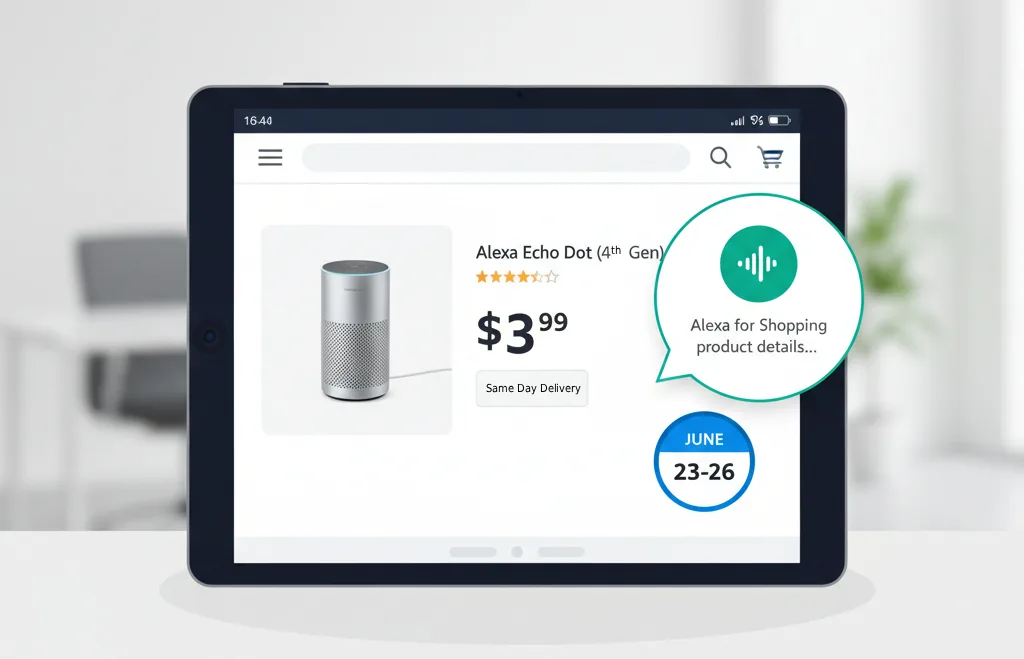
 Prime Day 2026 ran June 23 to 26, moved up from July, and drove $26.4 billion in U.S. online spend across all retailers, a 9.3% year-over-year increase, according to Adobe Analytics data reported by CNBC. The bigger shift for sellers was structural: this was the first Prime Day where Amazon put Alexa for Shopping, its merged Rufus and Alexa+ assistant, between the shopper and the deal. Your listing competed in a different kind of event, even though the discounts looked familiar.
Key Takeaways
-
Prime Day 2026 ran June 23 to 26, the first June event since 2021, which compressed seller prep windows by several weeks.
-
U.S. online spend reached $26.4 billion during the four-day window, up 9.3% year over year and just above Adobe’s $26.3 billion forecast.
-
That $26.4 billion is total U.S. e-commerce measured by Adobe during the window, not Amazon’s own sales. Amazon does not release Prime Day dollar figures.
-
Shoppers traded up: the share of the most expensive purchases rose 19% against the year-to-date average, and the most expensive electronics segment jumped 51% (Adobe).
-
The calendar got crowded. Walmart and Target ran competing June events, and about 40% of 68 tracked retailers were more promotional than last July (Telsey Advisory Group).
-
This was the first Prime Day with Alexa for Shopping positioned as the deal-finding layer, which changes what a listing has to do during peak demand.
What were the headline numbers for Prime Day 2026?
U.S. shoppers spent $26.4 billion online during the June 23 to 26 window, a 9.3% year-over-year increase, according to Adobe Analytics. That came in just above Adobe’s pre-event forecast of $26.3 billion.
The number is best read as a category signal, not an Amazon scorecard. Adobe measures total U.S. e-commerce across retailers during the window, and Amazon itself does not publish Prime Day sales dollars. So the $26.4 billion captures the whole online market the event pulls into motion, including the competing June sales at Walmart and Target. Retail Dive’s recap put the spend within range of a holiday weekend.
Buy now, pay later added $2.1 billion, about 6.6% of online orders, with BNPL order volume up 9.5% year over year. The table below sets the 2026 window against 2025.
U.S. Prime Day window spend and category discounts, 2025 vs 2026
|
Metric |
2025 |
2026 |
|
U.S. online spend (event window) |
$24.2B |
$26.4B |
|
Year-over-year growth |
n/a |
+9.3% |
|
Electronics (peak discount) |
23% |
24% |
|
Apparel (discount) |
24% |
24% |
|
Appliances (discount) |
16% |
16% |
|
Toys (discount) |
19% |
20% |
Source: Adobe Analytics, via Retail Dive.
Why did Amazon move Prime Day to June?
Amazon moved Prime Day to June 23 to 26 to get ahead of a crowded July. The company says it weighs major calendar events when setting the dates, and 2026’s July was dense with the FIFA World Cup, which runs June 11 to July 19, and the 250th anniversary of U.S. independence on July 4. It is the second June Prime Day ever and the first since 2021, and the calendar shifted forward by about two weeks.
For sellers, the date change was the most operationally disruptive part. Inventory cutoffs and deal-submission deadlines moved up by several weeks versus a typical July event, which caught brands that plan around a mid-July rhythm. If you missed an FBA inbound window this year, that compression is why.
The timing also dropped Prime Day into a crowded stretch. Walmart and Target ran competing June events, and Digital Commerce 360’s breakdown of the move notes other retailers now schedule promotions around it. Telsey Advisory Group found about 40% of 68 tracked retailers were more promotional than last July. The event is less an Amazon-only moment now and more a mid-year discount season that Amazon anchors.
What did shoppers buy, and what does it signal for margin?
Shoppers spent on higher-ticket, longer-lasting goods, with electronics, appliances, tools, and home and garden leading. Adobe found the share of the most expensive purchases rose 19% against the year-to-date average.
The trade-up was sharpest in electronics, where the most expensive segment jumped 51%, with similar movement in toys, appliances, and furniture. Deep discounts did the work. Analysts cited by CNBC tied the spending to inflation pressure and a tax-refund tailwind, conditions that will not repeat in the fall.
For sellers, the margin read is direct. Buyers concentrated around the deepest discounts and the highest-consideration items, which rewards brands that planned promotional depth deliberately rather than matching the field reflexively. A heavily promoted SKU that wins volume at a thin margin is a different outcome than one that wins because the listing answered the buyer’s question first.
What changed for sellers that the sales numbers don’t show?
This was the first Prime Day where Amazon positioned Alexa for Shopping, the assistant it formed by merging Rufus and Alexa+ in May 2026, as the way members find and track deals. The discovery layer moved, even though the discount layer looked familiar.
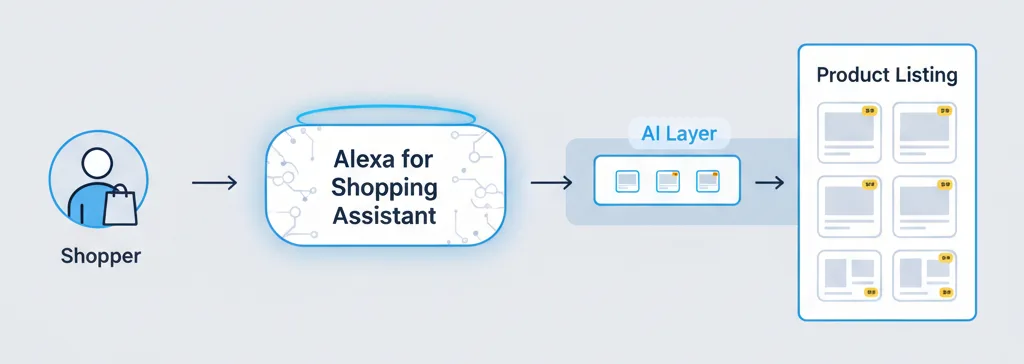
Amazon promoted Alexa for Shopping as the member’s guide to the event: build a personalized deals guide, set price alerts, check price history, and let the assistant surface relevant products. When an AI assistant assembles the shortlist, your listing is being read and summarized by a model before a human ever sees it.
One honest caveat: Amazon has not released data on how much Prime Day demand actually flowed through Alexa for Shopping, so treat its role as Amazon-positioned, not independently measured. The directional point still holds. The assistant is now a default surface during peak demand, and the brands that get summarized accurately are the ones whose listings give a model a clean, complete answer.
How should Amazon brands optimize listings for an AI-mediated Prime Day?
Write the listing to answer the questions a shopper asks an assistant, not just to rank in a search grid. Completeness and clarity beat keyword density when a model is doing the reading.
Start with natural-language coverage. Map the questions buyers actually ask about your category, compatibility, materials, use cases, and what is and is not included, then make sure the title, bullets, and A+ content answer them in plain language. A listing that states “compatible with standard 2-inch curtain rods” gives the assistant a citable fact. “Premium quality design” gives it nothing to work with.
Then structure for parsing. A+ content and bullets should read as discrete, factual statements rather than marketing runs, because that is what a model extracts cleanly. Reviews matter here too: when buyers describe a use case in reviews, that language feeds the assistant’s summary, which makes reviews a content channel, not just social proof.
If you want to see how your top SKUs read to an AI assistant before the next peak event, that is what our Listing Intelligence audit checks.
Action checklist
-
Pull your Prime Day 2026 sell-through by SKU and compare it against your promotional depth, so you can separate volume that came from price from volume that came from demand.
-
Reset your demand forecast for the rest of 2026 using the actual surge multiplier you saw this June, not last year’s July baseline.
-
Test three natural-language queries about your top product in Alexa for Shopping, and note whether the assistant describes your item accurately.
-
Audit your title and bullets for unanswered buyer questions: compatibility, sizing, materials, and what is included.
-
Rewrite vague A+ content claims into discrete factual statements a model can extract.
-
Mine your recent reviews for the use cases buyers name, and make sure those use cases appear in your listing copy.
-
Mark the next peak event (Prime Big Deal Days, typically October) on the calendar now and back-plan inventory cutoffs against a possible earlier date.
Prime Day is an AI-discovery event now, not just a discount event.
Frequently Asked Questions
Prime Day 2026 ran June 23 to 26, 2026, a four-day event. Amazon moved it from its usual mid-July slot, making it only the second June Prime Day ever and the first since 2021.
U.S. shoppers spent $26.4 billion online during the June 23 to 26 window, up 9.3% year over year, according to Adobe Analytics. That figure is total U.S. e-commerce during the window, not Amazon’s own sales, which Amazon does not publicly report.
Amazon shifted the event earlier in the year and kept the four-day format introduced in 2025. The practical effect for sellers was a compressed prep window, with inventory and deal deadlines moving up by about three to six weeks.
Alexa for Shopping is the assistant Amazon created by merging Rufus and Alexa+ in May 2026. For Prime Day 2026, Amazon positioned it as the way members find deals, set alerts, and track prices, which puts an AI layer between shoppers and product pages.
Write your listing to answer the natural-language questions buyers ask, and state facts plainly so a model can extract them. Cover compatibility, materials, sizing, and use cases in your title, bullets, and A+ content, and keep claims specific rather than promotional.
Yes. Walmart and Target ran their own June events, and Telsey Advisory Group found about 40% of 68 tracked retailers were more promotional than last July. Prime Day now anchors a broader mid-year discount season rather than standing alone.
Ready to stop leaving money on the table?
Get a free margin audit and see exactly how much profit you're missing.
Book Your Free Audit →