Why the Subscribe & Save “Set It and Forget It” Pricing Playbook Is Now a Liability: The Four-Layer Pricing Strategy That Replaces It
 Jun 1, 2026
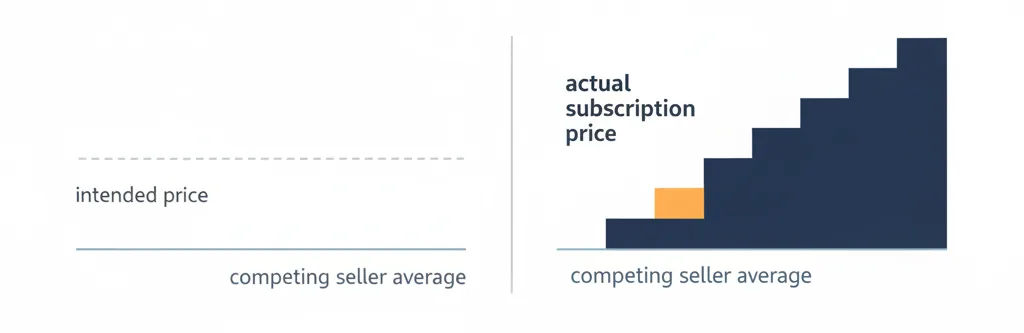
 On May 15, 2026, three law firms filed Herman v. Amazon.com, Inc. in the Western District of Washington. The complaint alleges Amazon’s Subscribe & Save program uses artificially low entry prices to capture subscribers, then drifts those prices upward to amounts higher than what other sellers charge for the same product. The plaintiffs call it “Subscribe & Switch.” The alleged conduct dates to February through October 2024; the complaint was filed in May 2026 after the firms assembled a class-wide theory. Whatever the legal outcome, the lawsuit names the specific pricing pattern that has been the standard agency-recommended playbook for years.
For brands running aggressive S&S price drift, the dollar math no longer compensates for the new risk profile.
One Minute Recap
The standard “max your Subscribe & Save discount, raise prices gradually after enrollment” tactic now carries three compounding risks: legal exposure, account-health scrutiny, and conversion damage. The four-layer replacement strategy treats S&S as one input in a coordinated pricing system: base price discipline, S&S spread guardrails, coupon and deal layering, and Buy Box price-floor monitoring. This piece walks the math, the policy boundary, and the operator move.
Key Takeaways
-
The Herman v. Amazon class action, filed May 15, names the specific pricing pattern (artificially low entry, post-enrollment price drift above competing sellers) that many agencies have recommended for years.
-
Dollar math from the complaint: a coffee subscription climbed from roughly $17 to nearly $29 between February and October 2024, with the final subscription price ending higher than what competing sellers on Amazon charged for single units of the same product.
-
Layer 1, Base price discipline. Set the everyday price first against true unit economics, then design the S&S spread against that base. The discount is a derivative, not the input.
-
Layer 2, S&S spread guardrails. Cap the subscription price at the lower of (a) base minus stated discount or (b) average competing seller price for the same week.
-
Layer 3, Coupon and deal layering. Use one-time mechanisms (coupons, Lightning Deals, Best Deals) for price exploration and acquisition. Reserve S&S for predictable retention only.
-
Layer 4, Buy Box price-floor monitoring. Competitor price-promoted ads, coupons, and repricer-driven undercutting silently move the Buy Box floor. A frozen S&S spread on a moving Buy Box floor recreates the Herman pattern accidentally.
Why is the standard “max discount, raise prices later” Subscribe & Save tactic now a liability?
Because the Herman complaint names that exact tactic as the harm. The plaintiffs allege Amazon enters the S&S relationship by outbidding third-party sellers to win the lowest price, captures the customer’s subscription, and then raises prices on subsequent shipments, often above the prices the same customer could have paid by buying single units from competing sellers. Stritmatter Law’s primary release documents a coffee subscription that moved from roughly $17 to nearly $29 between February and October 2024.
The risk isn’t hypothetical, and it isn’t limited to Amazon as a defendant. Three downstream risks now load onto every brand running the standard playbook:
-
Legal exposure. Plaintiff firms commonly expand class definitions over time. The Herman complaint targets Amazon, but the underlying pricing pattern is implemented by individual brands at the SKU level.
-
Account-health scrutiny. Cancellation cascades and customer complaints rooted in price drift create the kind of customer-harm signals Amazon’s automated systems escalate. Account-health flags can trigger weeks or months before legal complaints surface, since Amazon’s systems react to customer signals long before any class action firm assembles a case.
-
Conversion damage. A subscriber who cancels mid-relationship after seeing a price hike doesn’t just walk away. They leave a one-star review citing price gouging. That review compresses your Buy Box win rate and increases your PPC cost per click until the review’s weight in Amazon’s ranking signal decays.
How does the four-layer pricing strategy work?
It separates the four pricing decisions that the old “set S&S discount and forget it” approach collapsed into one. Each layer carries its own discipline, its own A/B test territory, and its own owner inside an operations team. The point is not to add complexity. The point is to surface the decisions that were always being made implicitly, so they can be audited and defended.
Layer 1: How should base price discipline work?
Set the everyday price first, against true unit economics: COGS plus the loaded fulfillment fee plus your target margin plus your allocated ad cost. Then design the S&S spread against that base. The discount is a derivative of the base, not the input.
The Herman pattern emerges when this order gets reversed. A brand decides on a target S&S discount (say, 15%), then sets a low promotional base to fund the discount, then raises the base to recover margin. The customer experiences the base hike as a subscription price hike because the discount stayed constant. The plaintiffs call that “bait and switch.” Amazon’s automated review systems may eventually call it the same.
A/B test territory: base price elasticity. Test plus or minus 5% on the base price while holding the S&S spread constant. Measure unit velocity, conversion rate, and total contribution margin. The brands we audit at Amazify often find their base is set below where elasticity would actually let them price; the test surfaces the gap before any S&S re-pricing decision gets made.
A pricing audit usually surfaces SKUs where the base is mispriced and other SKUs where the S&S spread is creating risk. Amazify’s pricing audit walks both at the same time.
Layer 2: What guardrails should the Subscribe & Save spread carry?
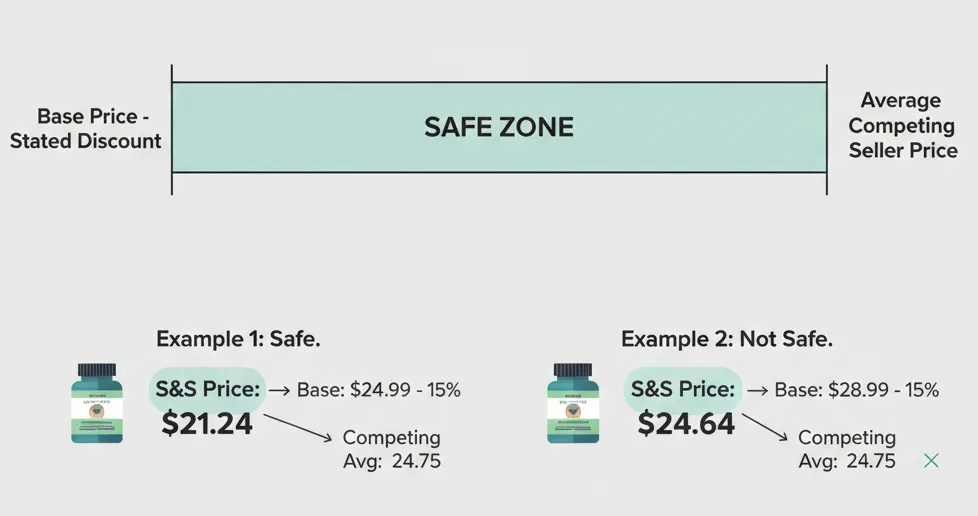
Cap the S&S subscription price at the lower of two thresholds: (a) base price minus your stated discount, or (b) average competing seller price for the same week. The second threshold is what prevents the Herman pattern.
Concrete example. A pet supplement brand sells a 60-count chew for $24.99 base, 15% S&S discount, subscription price $21.24. Competing sellers on the same listing run $22.50 to $26.00.
The S&S price is below the competing average. Safe.
Six months into the subscription program, the brand quietly raises the base to $28.99 to absorb a freight surcharge. The S&S subscription price now sits at $24.64. Competing sellers shifted slightly to $23.00 to $26.50, but the average is now $24.75. The S&S price has crept above the competing average. Not safe. Subscribers who comparison shop find they can buy single units cheaper from another seller on the same page. That’s the moment cancellation cascades begin.
A/B test territory: S&S take-rate by discount tier. Run 5%, 10%, and 15% on new subscriber cohorts only (never on active subscribers, since retroactive changes to active subscriptions are themselves a customer-harm signal). Measure subscription take-rate, 90-day retention, and total margin per subscriber.
Layer 3: Where do coupons, Lightning Deals, and Best Deals fit?
One-time mechanisms are the right tools for the work that S&S is wrong for: price exploration, customer acquisition, seasonal lift, and inventory clearance. Coupons let you test price points without locking the result into a recurring relationship. Lightning Deals and Best Deals create episodic visibility lift without contaminating your steady-state pricing.
The mistake the old playbook made was using S&S as the universal discount vehicle. S&S is the wrong tool for acquisition because it locks the price relationship into the customer relationship. It is the right tool only for predictable retention on truly consumable products with stable demand and stable supply.
A/B test territory: coupon stacking on top of S&S. Does a 10% coupon on first S&S delivery lift take-rate enough to justify the margin hit, or does it primarily attract subscribers who cancel after delivery one? The answer varies by category. Test before you assume.
Layer 4: How should you monitor Buy Box price-floor compression?
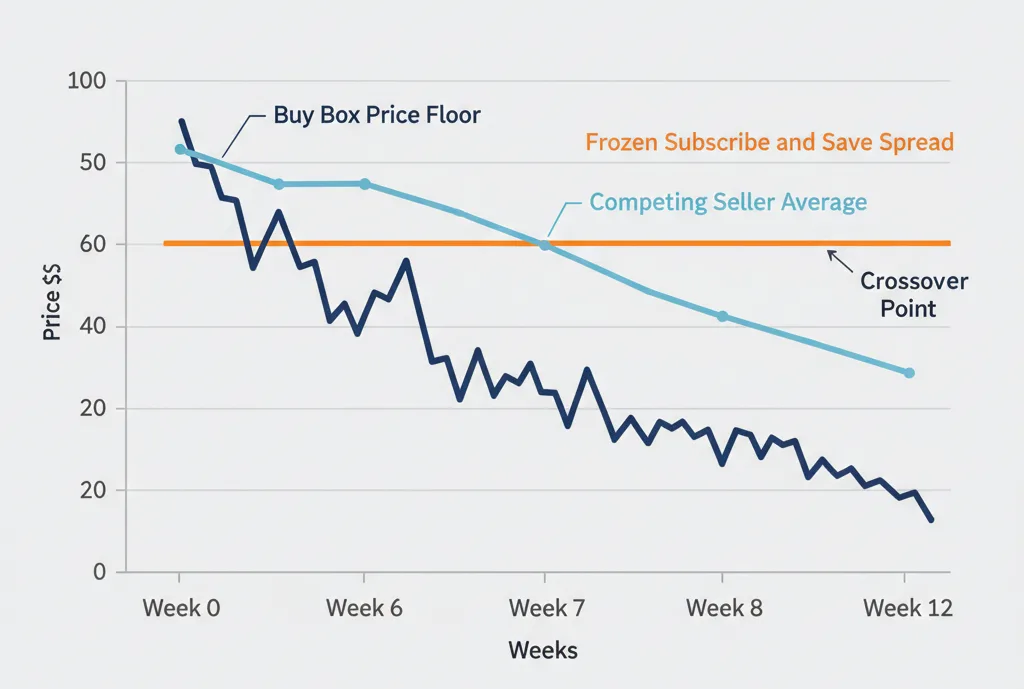
Competitor pricing pressure silently moves the Buy Box floor over time. The drivers are specific: price-promoted ad campaigns (Sponsored Brands and Sponsored Display with coupon overlays), competitor-issued coupons stacked on top of base pricing, and repricer software that automatically undercuts your offer by a configurable margin. Aggressive bidding alone doesn’t move the floor; the floor moves when those discounting mechanics fire inside competitor strategies.
Buy Box floor and competing seller average move together but aren’t the same number. Layer 2 uses the competing average as its threshold check; Layer 4 watches the Buy Box floor as the leading indicator, since the floor shifts first and the competing average follows. Your frozen S&S spread, set against last quarter’s competing average, accidentally drifts above this quarter’s competing average. You recreate the Herman pattern without ever raising your own price.
The operational discipline is a weekly Buy Box price-floor check on your top 20 SKUs. Track the average competing seller price (excluding your own offers) and decompose the movement by mechanic: coupon-driven, deal-event-driven, or repricer-driven. Recalibrate the S&S spread when the gap closes. The same check feeds the PPC team: a Buy Box floor drifting downward from competitor coupons means your own ad bids need to move or your conversion rate will compress against the new effective price point.
A/B test territory: ad spend response curves at different Buy Box price-floor positions. The same campaign performs differently at the same ACoS target depending on where the floor sits relative to your offer. Most brands run one bid strategy across all conditions. Brands that segment bid strategy by Buy Box floor position consistently recover meaningful PPC efficiency; the size of the recovery varies by category and competitive density.
What should an Amazon brand do this week to start the transition?
Start diagnostic, not strategic. Before committing to a new pricing structure across the catalog, surface where the risk actually lives by auditing the SKUs already enrolled in Subscribe & Save against current competitor pricing. Brands typically find the exposure concentrated in a small subset of SKUs that share three traits we see together in audits: long enrollment history, base-price increases the team didn’t flag as S&S risk, and a competing seller average that has shifted downward since enrollment. The transition starts there. Everything else stays as-is while the new operating rhythm gets built.
The Action Checklist below covers the diagnostic first, then the post-diagnostic moves.
The Subscribe & Save Pricing Audit Checklist
-
Pull 12-month price history for every SKU enrolled in Subscribe & Save.
-
For each SKU, calculate current S&S subscription price vs. average competing seller price (same listing, past 8 weeks).
-
Flag every SKU where S&S price exceeds the competing seller average.
-
For each flagged SKU, decide: legitimate margin work (document the rationale in writing) or unintentional drift (re-set the price).
-
Set up a weekly Buy Box price drift monitor for top 20 SKUs.
-
A/B test one of the four layers in the next 30 days. Document the result.
-
Write your pricing policy down. The documentation is itself the account-health defense if a future complaint surfaces.
Pricing on Amazon is no longer a setting. It’s a system, and the brands that treat it as a system are the ones that survive the next regulatory wave.
Frequently Asked Questions
Yes. Run it the way the four-layer strategy describes. The lawsuit doesn’t threaten the program itself; it threatens a specific pricing pattern that brands have been using inside the program. Brands that price S&S spreads conservatively against competing seller averages carry essentially no incremental risk and continue to capture the retention benefit.
The safe range is whatever sits at or below the average competing seller price for the same listing in the same week. A 5% discount can be unsafe if the resulting subscription price exceeds competitor averages. A 15% discount can be safe if the base is priced correctly and competitor floors are stable. There isn’t a single percentage answer because the safe zone is defined by the relationship between your price and the competing seller average, not by any single discount tier.
Not at signup, but per shipment. Subscribe & Save prices change between deliveries; Amazon’s own policy (https://www.amazon.com/gp/help/customer/display.html?nodeId=GJ2LTMLFGGMH67M7) states that the price quoted in the pre-shipment reminder email is the locked ceiling for that order and that the customer will never be charged more than the price shown in that email. The Herman complaint is built on the cumulative effect of those between-shipment changes across many cycles, not on a single surprise charge. Subscribers signed up expecting the discount to translate into ongoing savings, then watched the underlying base price climb. The pre-shipment email is the customer’s last clean exit point per order, which is exactly why cancellation cascades cluster around the days price-change emails go out. If price stability matters to the subscriber, the brand has to enforce that stability operationally through the Layer 2 spread guardrails. Amazon’s program doesn’t enforce it for them.
Prices can change between shipments. Amazon doesn’t enforce a minimum interval or maximum percentage change between renewals, but each change is disclosed in the pre-shipment reminder email and the customer can skip or cancel before that order processes. That disclosure window is the system’s built-in customer protection and is central to Amazon’s likely defense in Herman. The seller-side discipline is to make sure the disclosed price is also defensible against the competing seller average so that the customer who reads the email doesn’t have a clean reason to cancel and complain.
Monthly minimum for drift detection. Quarterly for strategic resets. The drift check is automated work; the strategic reset is a deliberate review of base price, S&S spread, coupon mix, and Buy Box dynamics together as a system.
Yes. The Subscribe & Save program is selling-model agnostic. FBA, FBM, and vendor (1P) brands all run S&S enrollment through the same mechanics. The pricing pattern is what the complaint is about, not the fulfillment model.
Direct customer-harm patterns (cancellation spikes, price-related negative reviews, customer service complaints citing price) can trigger account-health flags independent of any legal exposure. The flag risk is faster-moving than the legal risk and warrants more immediate attention.
Yes. Test only on new subscriber cohorts. Never on active subscriptions. Retroactive changes to active subscriptions are themselves a customer-harm signal and recreate the Herman pattern in miniature. New-cohort testing produces clean data and avoids the risk surface entirely.
Ready to stop leaving money on the table?
Get a free margin audit and see exactly how much profit you're missing.
Book Your Free Audit →